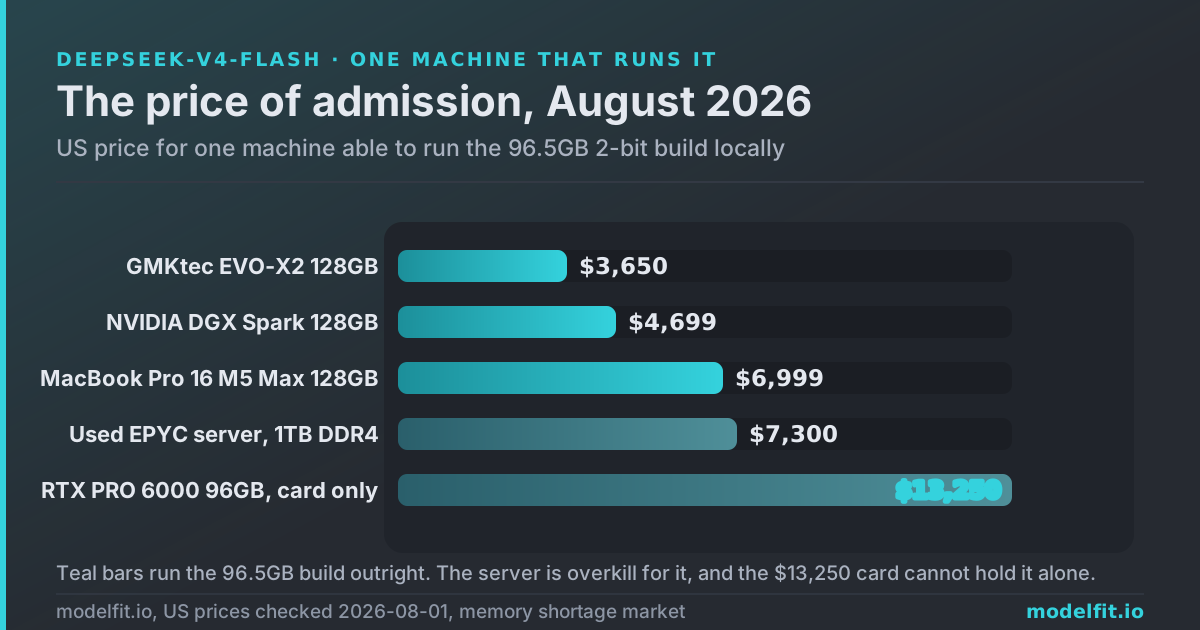
The cheapest new machine that runs DeepSeek-V4-Flash locally costs about $3,650 in August 2026: a 128GB AMD Ryzen AI Max+ 395 mini PC, currently listed at $3,649.99 (price tracker, 2026). The Apple path is a $6,999 MacBook Pro. The single GPU with almost enough VRAM costs $13,250 and still cannot hold the model alone. This guide prices every path, with the memory shortage baked in.
How much memory does DeepSeek-V4-Flash need?
You need a 128GB-class machine. The smallest good build of this 284B-parameter model is the 2-bit DQ MLX conversion at a measured 96.5GB, with the UD-Q2_K_XL GGUF right behind at 96.8GB (measured quant sizes, 2026). The absolute floor is the 82.5GB UD-IQ1_S build, which trades real quality for the smaller file.
So the shopping question is simple: what is the cheapest way to put roughly 100GB of model plus KV cache headroom behind a fast memory bus? In August 2026, mid memory shortage, there are four serious answers and one trap.
What does the Mac path cost?
Disclosure: the Amazon links below are affiliate links. ModelFit earns a commission if you buy, at no extra cost to you.A 16-inch MacBook Pro with the M5 Max chip and 128GB of unified memory lists at $6,999 with 2TB of storage (current config pricing, 2026). That is the cleanest consumer machine for this model, and the price reflects two rounds of pain: Apple raised US Mac prices on June 25, and the memory upgrade options for the M5 Max doubled in price at the same time (9to5Mac, 2026). A fully maxed 16-inch now reaches $10,149 with 8TB of storage, per the same report.
What you get for the money is the best measured performance of any machine on this list. The build generates about 39 tokens per second on a 128GB M5 Max in antirez's ds4 engine, and about 27 on an M3 Max, per the August 2026 README (antirez/ds4, 2026).
One thing you cannot do is buy a bigger Mac instead. Apple retired the 256GB and 512GB Mac Studio tiers during the shortage, so the Mac Studio now tops out at 96GB and the 128GB MacBook Pro is the largest-memory Mac sold new (why that matters for this model, 2026). Used 192GB M2 Ultra and 256GB M3 Ultra Studios do circulate, at four-figure prices in a thin and noisy market, and they are the only Mac route to the higher-quality 3-bit and 4-bit builds.
| Mac option | Memory | US price, checked Aug 1, 2026 | Runs which build |
|---|---|---|---|
| MacBook Pro 16 M5 Max, 2TB | 128GB | $6,999 new | 2-bit DQ, 96.5GB |
| MacBook Pro 16 M5 Max, maxed | 128GB | $10,149 new | 2-bit DQ, 96.5GB |
| Mac Studio M3 Ultra, new | 96GB max | $5,299 base | None, misses the floor |
| Mac Studio M2 Ultra, used | 192GB | Used market only, varies | 3-bit DQ and below |
The 96GB Mac Studio row is the trap flagged above: it costs flagship money and cannot load even the 82.5GB floor build once macOS takes its share.
What is the cheapest 128GB machine?
The AMD Ryzen AI Max+ 395 platform, by a wide margin. A GMKtec EVO-X2 with 128GB of unified memory lists at $3,649.99 as of July 31, up from a $2,199.98 low in January before the shortage repriced memory (price history, 2026). Our own July 31 scan of 21 Amazon listings for 128GB machines on this chip put the range at roughly $2,600 to past $5,000 (Strix Halo price update, 2026), with the median near $3,850. Full specs and current model picks live on our Ryzen AI Max+ 395 page.
Speed lands in the same band as the Macs. Lucebox, a vendor selling these boxes, reports the V4-Flash preview reaching up to 32 tokens per second of decode on 128GB (Lucebox, 2026). Treat that as a vendor number, but it agrees with the measured Mac figures: the 13B-active MoE design keeps decode usable on every 128GB unified-memory machine.
NVIDIA's DGX Spark is the other 128GB box, now $4,699 after an 18 percent shortage price hike from its $3,999 launch (Tom's Hardware, 2026). Know what you are buying: in the ds4 measurements the Spark prefills far faster than any Mac but generates under 14 tokens per second, less than half the M5 Max rate (antirez/ds4, 2026). It is a CUDA development box first and a chat machine second.
Can a GPU rig do it for less?
No, and the flagship card cannot even do it alone. NVIDIA's RTX PRO 6000 Blackwell carries 96GB of VRAM and now lists at $13,250 on NVIDIA's own marketplace, about 55 percent above its launch price (Tom's Hardware, 2026). The 96.8GB Q2 GGUF does not fit in 96GB of VRAM. Only the 82.5GB quality-floor build loads fully on the card, with modest context. You would pay 3.6 times the price of the AMD box to run a worse quant.
The used route is stacking RTX 3090s at roughly $900 each. Five cards give 120GB of VRAM for about $4,500, but that is before the server board, the power supplies for a multi-kilowatt rig, and the assembly time. For a 13B-active MoE that already decodes at chat speed on a $3,650 box drawing under 200W, the multi-GPU rig is an enthusiast project, not the value play. GPU rigs earn their money on dense models and batch serving, not on this workload.
Why not a CPU server?
Because this model is too small to justify one. The used-EPYC path shines when weights outgrow every consumer machine: our Kimi K3 build guide prices a dual-socket 1TB DDR4 server at about $7,300, and K3's smallest real quant needs 567GB, so there the server is the only local option. DeepSeek-V4-Flash needs 97GB. Every dollar past 128GB of capacity is wasted on it, and DDR4 bandwidth cannot match a unified-memory APU for single-user decode anyway.
The honest rule during the shortage: buy capacity for the model you actually want to run. RAM is the majority of any AI build's cost right now, and the RAM sizing guide maps exactly how much each model tier needs before you spend anything.
What if you spend nothing on hardware?
Renting or using the API is far cheaper until your usage is constant. On RunPod, an RTX PRO 6000 rents for $1.99 per hour and an H100 NVL for $3.19 (RunPod pricing, 2026). At the $1.99 rate, the $3,650 AMD box equals about 1,800 rental hours, two and a half months of round-the-clock use. Rent first, buy when the meter proves you should.
The API case is even more lopsided. DeepSeek charges $0.14 per million input tokens on a cache miss and $0.28 per million output tokens (DeepSeek pricing, 2026). The price of the AMD box buys roughly 13 billion output tokens. Local hardware is not how you save money on this model. You buy it for privacy, offline work, and unmetered agent loops.
Which path should you pick?
| Path | Cost, Aug 2026 | Pick it when |
|---|---|---|
| AMD Ryzen AI Max+ 395, 128GB | ~$3,650 | Cheapest way in, Linux is fine |
| NVIDIA DGX Spark, 128GB | $4,699 | CUDA dev work, prefill-heavy loads |
| MacBook Pro 16 M5 Max, 128GB | $6,999 | Fastest decode, it is also your laptop |
| Used dual-EPYC server, 1TB | ~$7,300 | Only for far bigger models, wrong tool here |
| RTX PRO 6000, 96GB | $13,250 | Not for this model, weights do not fit |
| RunPod rental | $1.99/hr | Under ~1,800 hours of total use |
| DeepSeek API | $0.14/1M input | You do not need local at all |
If you already own a machine, check what it runs before spending anything: the modelfit wizard covers every Mac, GPU and RAM tier, or run npx @wecko-ai/modelfit in a terminal. And see how V4-Flash class open models compare with the cloud flagships on the benchmark leaderboard.
FAQ
What is the cheapest way to run DeepSeek-V4-Flash locally?
A 128GB AMD Ryzen AI Max+ 395 mini PC, around $3,650 in August 2026. It holds the 96.5GB 2-bit build with room for KV cache, and vendor-reported decode reaches up to 32 tokens per second. Before the memory shortage the same box sold near $2,200, so today's price is the shortage tax, not the historical norm.
Can a single GPU run DeepSeek-V4-Flash?
Not the good builds. The largest single-card VRAM pool is the RTX PRO 6000 at 96GB, and the 2-bit GGUF measures 96.8GB, so it does not fit. Only the 82.5GB 1-bit floor build loads on one card, with limited context. Multi-GPU setups work but cost more than a unified-memory box for this workload.
Is the MacBook Pro worth double the AMD box?
It is the fastest option measured so far, about 39 tokens per second on the M5 Max against a vendor-claimed 32 on the AMD chip, and you get a laptop, macOS, and the MLX ecosystem with it. If the machine is your daily computer anyway, the premium is easy to defend. If it will sit on a shelf running an agent, the AMD box does the same job for half the money.
Should I wait for hardware prices to drop before buying?
The 2026 memory shortage repriced every 128GB-class machine upward, and unified-memory boxes went up the most because memory is most of what you pay for. Nothing in the current supply picture points at quick relief, and our RAM price tracker post follows the story. Buy the capacity your target model needs, nothing more.
Is it cheaper to rent a GPU or use the API instead?
Almost always, at first. A 96GB cloud GPU is $1.99 per hour on RunPod, and the DeepSeek API serves this exact model at $0.28 per million output tokens. Hardware only wins once usage is constant: the break-even against the cheapest local box is about 1,800 rental hours. Local buys you privacy and unmetered loops, not savings.
Sources
- GMKtec EVO-X2 128GB price history, checked August 1, 2026: https://pricehistory.app/p/gmktec-evo-x2-ai-mini-pc-ryzen-0zI8VhQ2
- MacBook Pro 16 M5 Max 128GB configuration pricing: https://www.theresmac.com/product/macbook-pro-16-m5-max-128gb-ram
- 9to5Mac on the June 2026 MacBook Pro price increases: https://9to5mac.com/2026/06/29/a-maxed-out-16-inch-macbook-pro-now-has-a-5-figure-price-tag/
- Tom's Hardware, DGX Spark price increase to $4,699: https://www.tomshardware.com/desktops/mini-pcs/nvidia-dgx-spark-gets-18-percent-price-increase-as-memory-shortages-bite-founders-edition-now-usd4-699-up-from-usd3-999
- Tom's Hardware, RTX PRO 6000 Blackwell at $13,250: https://www.tomshardware.com/pc-components/gpus/nvidia-raises-rtx-pro-6000-blackwell-gpu-pricing-to-usd13-250-55-percent-increase-over-msrp-in-a-years-time
- RunPod GPU cloud pricing: https://www.runpod.io/pricing
- DeepSeek API pricing: https://api-docs.deepseek.com/quick_start/pricing
- antirez, ds4 inference engine speed measurements: https://github.com/antirez/ds4
- Lucebox, DeepSeek V4 Flash on Ryzen AI MAX+ 395: https://www.lucebox.com/blog/deepseek-v4-strix-halo
- Measured DeepSeek-V4-Flash quant sizes, HuggingFace API: https://huggingface.co/api/models/mlx-community/DeepSeek-V4-Flash-2bit-DQ
Match this model to a machine that can run it: by RAM tier for Apple Silicon, or by VRAM for an NVIDIA GPU.
The weekly local-AI refresh
New open-weight models, real Apple Silicon benchmarks, and the one model worth running on your Mac this week. Free, one email a week, unsubscribe anytime.
By subscribing you agree to our Privacy Policy and to receive the weekly email. Unsubscribe anytime.
Have questions? Reach out on X/Twitter