The ModelFit story
From one unanswered question to a guide for every Mac, iPhone and GPU. Scroll through every version of the site, with the numbers behind each step.
- Launched
- Feb 19, 2026
- Models in the catalog
- 156
- Clicks from Google
- 53,097since Feb 22, 2026
- Newsletter readers
- 543
Early 2026
A question Google could not answer
ModelFit started with a conversation. Glenn, a friend working on xybrid.ai, explained how language models can run locally, right on your own phone, with no cloud in between. It sounded like the future.
The next question came right away: which model can my Mac run? Google had no clear answer. ModelFit was built to give one.
Feb 19, 2026
Version 1 goes live
The first version went live on February 19, 2026: a single page where you picked a Mac and got a ranked list of 21 local models, each with the command to run it.
By the evening it had a dark neon look. That look stayed for the next three and a half months.
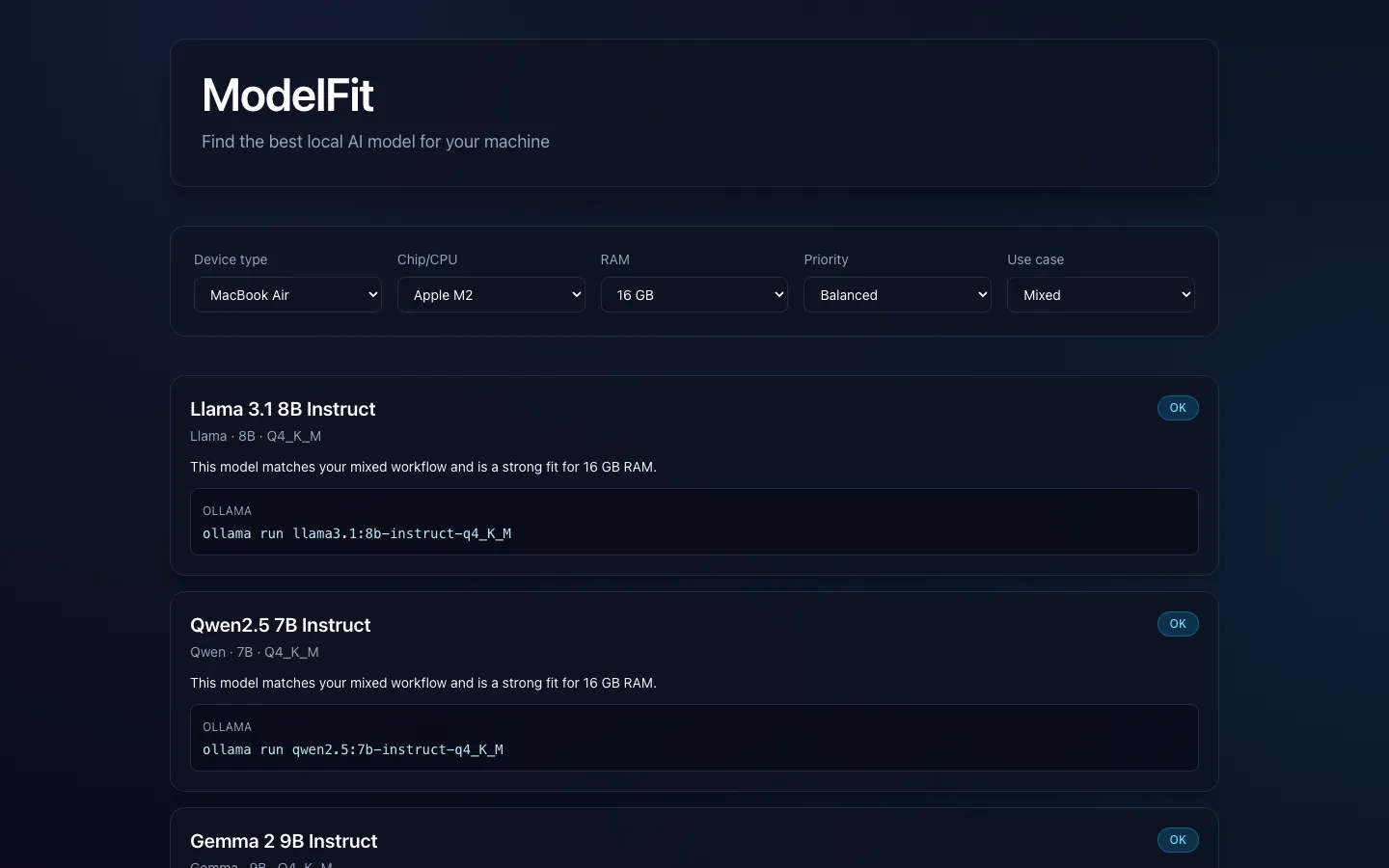
First buildFeb 19, 2026 Feb 20 to 22, 2026
iPhones, a wizard and the first visitor from Google
In three days the catalog grew to 56 models, iPhones joined the Macs, and the form became a step-by-step wizard. The first pages dedicated to each device went up.
On February 22, Search Console recorded the first click from Google.

WizardFeb 22, 2026 Feb 25 to Mar 30, 2026
A blog, a benchmark and a page for every question
The blog opened on February 25 with three articles, next to a first benchmark page.
By the end of March the site had 20 articles, model family pages, 16 model comparisons and 43 use-case pages.

WizardMar 4, 2026 April and May 2026
It grew on its own
ModelFit began as a side project, with no big plan behind it. Through April and May it only got occasional updates.
Google traffic kept climbing anyway: 811 clicks in April, 999 in May. That was the signal to take the project seriously.

WizardMay 31, 2026 June 2026
Getting serious
June brought the first real redesign, a soft interface that started light and switched to dark by default on June 14. The homepage was rebuilt around the answer, and the newsletter launched on June 1.
On June 15 the engine shipped on npm as a command-line tool, so the same recommendation runs in a terminal. Clicks from Google quadrupled in a month, to 4,070.

WizardJun 4, 2026 July and August 2026
A summer of tools
Over the summer the site added a hardware requirements calculator, a pooled VRAM calculator for multi-GPU rigs, and can-i-run pages that answer one model on one GPU.
Clicks reached 7,072 in July and 11,400 in August, and the newsletter passed 100 readers.

HomeAug 26, 2026 September 2026
A record month
September was the biggest month yet: 18,508 clicks from Google, with a single-day high of 778 on September 22.
A quantization comparison tool and VRAM calculators joined the site. The catalog grew to 152 models, the blog to 107 articles, and the newsletter doubled to 301 readers.

HomeSep 30, 2026 Oct 19, 2026
A new design
On October 19, 2026 the whole site moved to a new design: quieter, built on hairlines and data, with one configurator shared by the homepage, the Mac pages and the machine comparison.
Today the catalog holds 156 models and the blog 120 articles. Since the first click, Google has sent 53,097 clicks, and 543 people read the newsletter.
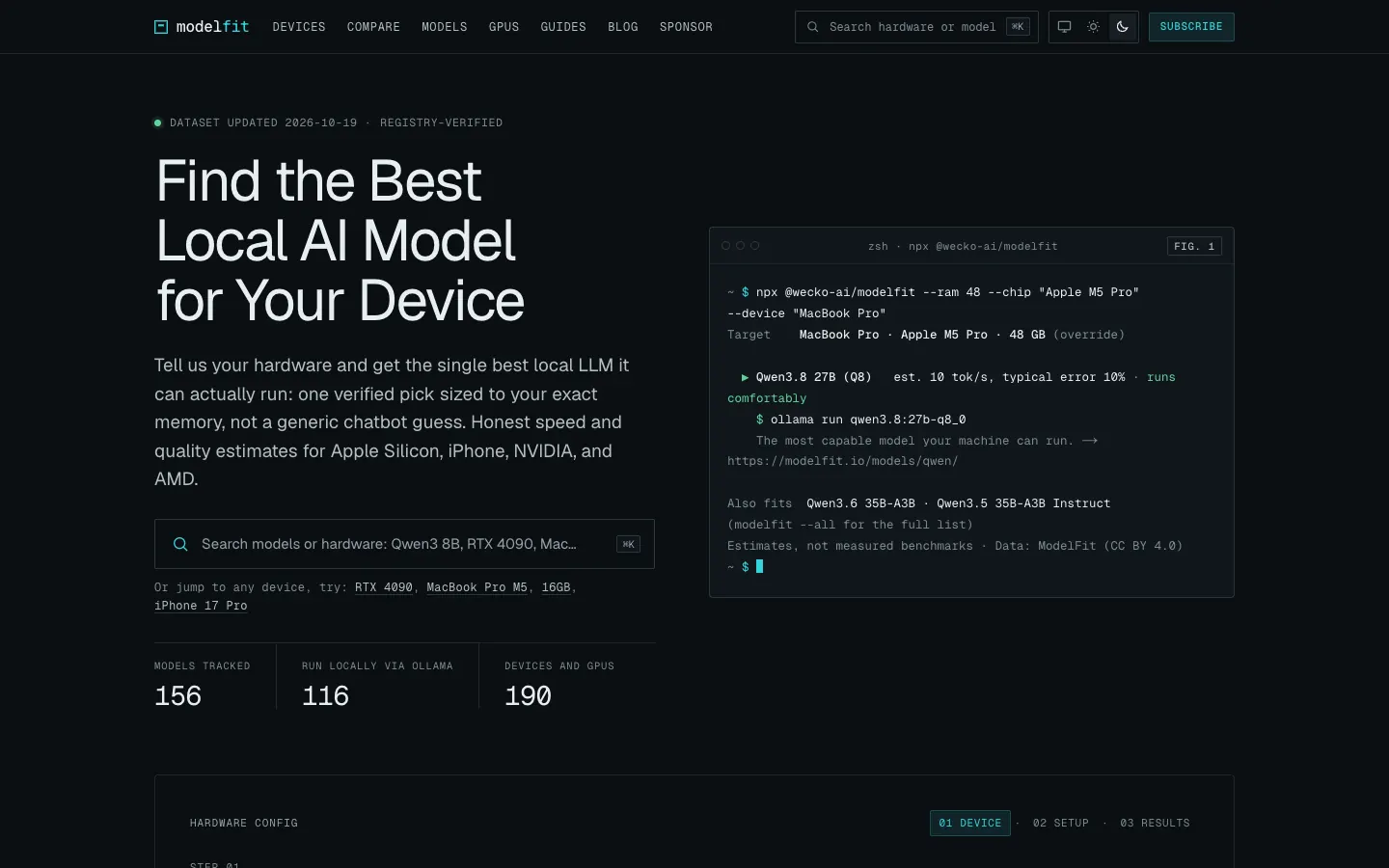
HomeOct 19, 2026
Sources. Clicks: Google Search Console, daily data from Feb 22, 2026 to Oct 16, 2026, the same series as the sponsor page. Newsletter readers: confirmed subscribers still on the list, counted by the month they joined. Models and articles: counted in the site's own repository at each date. Screenshots: each version rebuilt from the repository at the date shown.