TL;DR: The AMD Ryzen AI Max+ 395 ("Strix Halo") puts 128GB of unified memory in a mini PC, letting it load models up to ~200 billion parameters locally, something no consumer GPU can do. On Linux it exposes about 108GB to the GPU (CraftRigs), versus 24-32GB on an RTX 4090/5090. The catch: its 256 GB/s memory bandwidth trails Apple's M-series (546-819 GB/s), so big models run but generate slowly (~11 tok/s on a 235B model, per Tech Times). It launched at ~$1,999 for the 128GB config; the 2026 memory shortage has since pushed the category well past that (see the price update below). It remains the cheapest way to run frontier-size models at home.
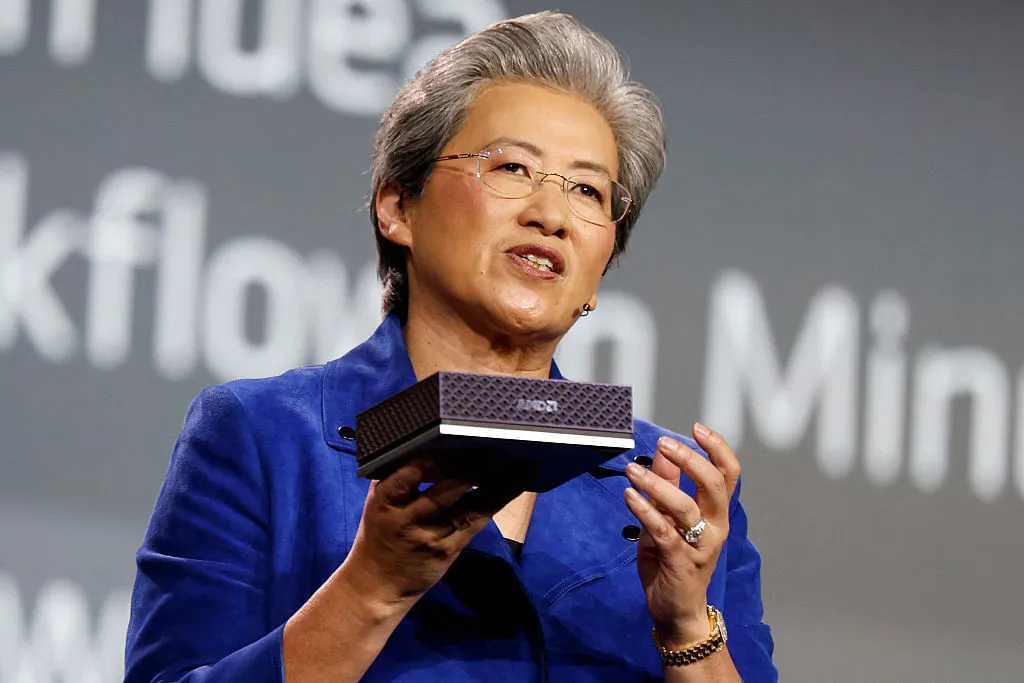 The AMD Ryzen AI Max+ 395 (Strix Halo) packs 128GB of unified memory into a book-sized mini PC.
AMD just made a move that matters for anyone running AI at home. At the CES 2026 keynote on January 6, CEO Lisa Su held up a mini PC and called it "the smallest AI development system in the world, capable of running models with up to 200 billion parameters locally" (Rev transcript). No datacenter. No cloud GPU rental. A box the size of a thick book.
The chip behind it, the Ryzen AI Max+ 395, is the first x86 part to fuse a fast CPU, a large GPU, and 128GB of shared memory on one package. That unified-memory design is exactly what Apple has shipped since the M1, and it is what lets these machines hold models that would never fit in a discrete graphics card. This guide covers what the chip actually does for local LLMs, where the hype overshoots, and how it stacks up against the Apple Silicon Macs that pioneered the approach. For sizing any model to any memory budget, see our how much RAM for a local LLM guide.
What Is the Ryzen AI Max+ 395 ("Strix Halo")?
Strix Halo is an APU, one chip carrying both processor and graphics, built for AI workloads. The headline specs:
| Spec | Ryzen AI Max+ 395 |
|---|---|
| CPU | 16 Zen 5 cores / 32 threads |
| GPU | Radeon 8060S, 40 compute units (RDNA 3.5) |
| NPU | XDNA 2, 50 TOPS |
| Memory | Up to 128GB LPDDR5x-8000, unified |
| Memory bandwidth | 256 GB/s (theoretical) |
| Default TDP | 55W (configurable 45-120W) |
The NPU figure of 50 TOPS comes from AMD's own announcement (AMD blog). The part that matters for local LLMs is not the NPU, though; it is the 128GB of memory the GPU can borrow from.
Why Unified Memory Beats a Big GPU for Large Models
A local LLM has to fit its weights in memory the accelerator can reach. On a normal PC, that means GPU VRAM, and VRAM is small and fixed.
| Hardware | Memory the GPU can use |
|---|---|
| RTX 4090 | 24 GB |
| RTX 5080 | 16 GB |
| RTX 5090 | 32 GB |
| Strix Halo (Linux) | ~108 GB |
On Linux, kernel tuning lets the Radeon 8060S address roughly 108GB of the 128GB pool through a shared GTT allocation (CraftRigs). That is more than triple an RTX 5090's 32GB. On Windows the GPU is capped at whatever you carve out in the BIOS, with no equivalent shared pool, so the big-model story is largely a Linux story today.
This capacity is the whole pitch. A 70B model at 4-bit needs about 42GB; a 120B model needs ~65GB. Neither fits on any single consumer Nvidia card. Both fit on Strix Halo with room to spare.
How Fast Is It, Really?
Here is where expectations need calibrating. Loading a model is not the same as running it quickly. Token generation is bound by memory bandwidth, and Strix Halo's 256 GB/s (about 215 GB/s measured in practice, per Tech Times) is modest next to a discrete GPU's or a high-end Mac's.
The result: dense large models load but crawl, while Mixture-of-Experts (MoE) models, which activate only a few billion parameters per token, fly.
| Model | Type | Est. generation speed | Source |
|---|---|---|---|
| Qwen3 235B (Q3) | MoE, huge | ~11 tok/s | Tech Times |
| Qwen3 30B-A3B | MoE, 3B active | ~72 tok/s | Level1Techs |
| gpt-oss-120b | MoE | ~52 tok/s | fromthematrix |
| Llama 3 70B (Q4) | Dense | ~5 tok/s | Level1Techs |
The takeaway: a 235B model running at ~11 tok/s is a genuine novelty, but it is reading-speed slow. The sweet spot for daily use is MoE models in the 30B-120B range, where Strix Halo delivers 50-70+ tokens per second, fast enough for interactive chat and agents.
Watch the benchmark wording. Some viral charts cite "144 tok/s on Qwen3 235B." That is prompt processing (how fast it reads your input), not generation (how fast it writes the answer). Generation on that model is ~11 tok/s. The two are routinely conflated.
The "3x Faster Than an RTX 5080" Claim, Explained
AMD published a benchmark in March 2025 showing the Ryzen AI Max+ 395 running DeepSeek R1 up to 3x faster than an RTX 5080 (TweakTown). True, with an asterisk.
That gap only appears once the model exceeds the RTX 5080's 16GB of VRAM. Below 16GB the Nvidia card is far faster. Above it, the 5080 has to spill weights into slow system RAM and falls off a cliff, while Strix Halo keeps everything in its 128GB pool. This is an AMD-run, vendor benchmark, and the sources do not state the exact DeepSeek R1 size or quantization, so treat the multiplier as a capacity story, not a raw-compute one. Strix Halo wins by fitting the model, not by being a faster chip.
Strix Halo vs Apple Silicon: The Honest Comparison
Apple shipped unified memory five years before Strix Halo. For our Mac-owning readers, the fair question is how AMD's version compares, and the answer splits cleanly between price, capacity, and bandwidth.
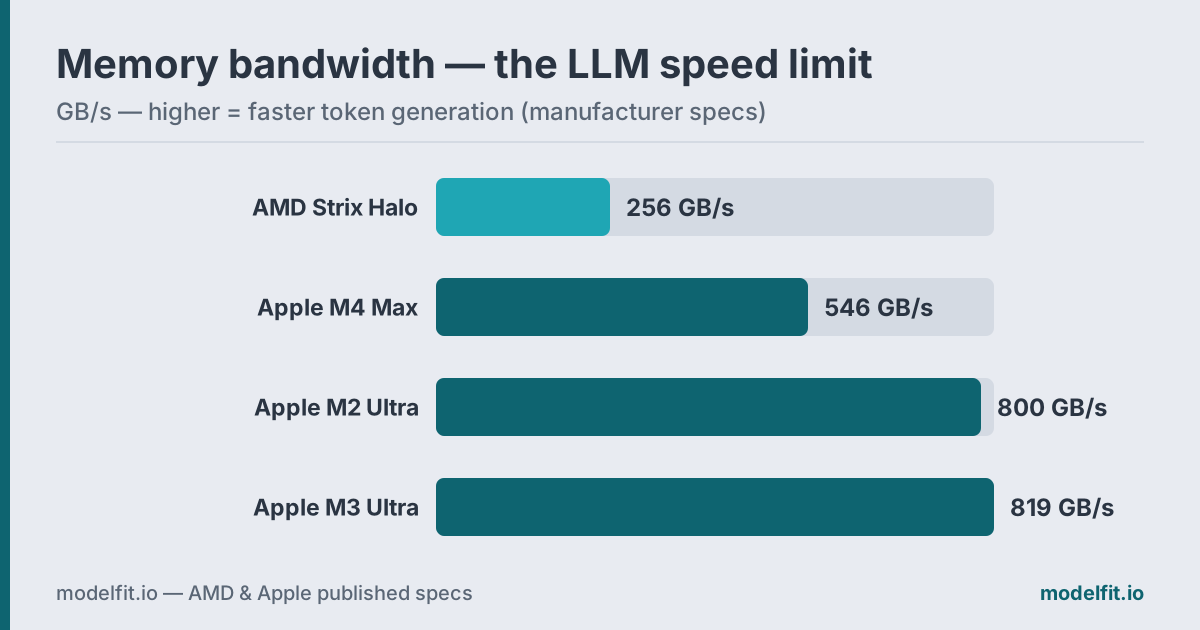 Memory bandwidth sets local LLM token speed. Strix Halo's 256 GB/s trails every Apple Ultra and Max chip. Manufacturer specs.
| Chip | Max unified memory | Memory bandwidth | Notes |
|---|---|---|---|
| AMD Strix Halo | 128 GB | 256 GB/s | mini PC, ~$1,999 at launch |
| Apple M4 Max | 128 GB | 546 GB/s | top configuration |
| Apple M2 Ultra | 192 GB | 800 GB/s | Mac Studio |
| Apple M3 Ultra | 512 GB | 819 GB/s | Mac Studio |
Sources: AMD/TechPowerUp, Apple M4 Max, Apple M2 Ultra, Apple Mac Studio specs.
Three honest conclusions:
- On price, AMD still wins, by less than it did. A 128GB Strix Halo mini PC launched around $1,999 and now sells well above that. A comparable 128GB Apple machine still costs more, but the gap has narrowed as the shortage hit unified memory hardest.
- On capacity, it ties the M4 Max (both 128GB) but loses to the Ultra chips; only an M3 Ultra (512GB) can hold dramatically larger models.
- On bandwidth, the metric that sets token speed, Apple wins everywhere. Even the two-generation-old M2 Ultra moves data ~3x faster. That is why a Mac of equal memory generates tokens faster than Strix Halo.
For a Mac owner, the verdict is plain: if you already run an M-series machine with enough RAM, Strix Halo offers little upside. Its real audience is price-sensitive builders who need 100GB-class model capacity cheaply and are comfortable on Linux/ROCm. See our Mac Studio local AI guide for the Apple side of this trade.
The Cost-vs-Cloud Math
The pitch beyond privacy is economics. Frontier AI subscriptions stack up: Claude, ChatGPT Pro, and Cursor can each run $20-$200 a month. A box that never sends a token off your machine still pays for itself inside a year or so against a heavy subscription stack, even at 2026 prices, and it removes token limits, rate caps, and 3 a.m. service outages.
The honest caveat: a local 235B model at ~11 tok/s is not a drop-in replacement for a frontier cloud model on hard reasoning tasks. Where local hardware shines is private RAG over your own documents, prototyping, local coding agents, and offline workflows: use cases where privacy and unlimited usage matter more than absolute peak quality.
Should You Buy One?
| You are... | Verdict |
|---|---|
| A Mac owner with 64GB+ unified memory | Skip it: you already have faster unified memory |
| A budget builder who needs 70B-120B models locally | Strong buy, especially on Linux, if the current price still clears your budget |
| Chasing maximum token speed | Get a discrete GPU (for models ≤24GB) instead |
| Privacy-first, running RAG/agents on private data | Excellent fit |
The Ryzen AI Max+ 395 does not beat a high-end Mac or a fast GPU at their own games. What it does is collapse the price of large-model capacity, putting 100GB-class local AI within reach of a single mini PC rather than a multi-GPU rig. That is the real story, and it survives the 2026 price rise intact.
FAQ
What is the AMD Ryzen AI Max+ 395?
It is AMD's flagship "Strix Halo" APU: a single chip with 16 Zen 5 CPU cores, a 40-compute-unit Radeon 8060S GPU, a 50 TOPS NPU, and up to 128GB of unified LPDDR5x memory. The unified memory lets the GPU access far more than a discrete card's VRAM, so it can load very large local LLMs.
Can Strix Halo really run a 235B model?
Yes, it can load a quantized 235-billion-parameter MoE model in its 128GB memory pool, which AMD demonstrated as part of its CES 2026 "up to 200 billion parameters" claim. But generation runs at roughly 11 tokens per second (Tech Times): usable, but slow. MoE models in the 30B-120B range are the practical sweet spot at 50-70+ tok/s.
How does Strix Halo compare to Apple Silicon for local AI?
It matches the M4 Max on memory capacity (128GB) and beats every Mac on price, but its 256 GB/s memory bandwidth is roughly half the M4 Max's 546 GB/s and a third of the M3 Ultra's 819 GB/s. Since token generation is bandwidth-bound, an equivalent-memory Mac generates tokens faster. Strix Halo's edge is cost, not speed.
How much does a 128GB Strix Halo mini PC cost?
The GMKtec EVO-X2 with 128GB launched at a pre-sale price of about $1,999, with street prices then fluctuating between roughly $1,800 and $2,300 (Notebookcheck). AMD's own first-party dev kit is reported at $3,999. The cheaper EVO-X2 is the 64GB version, which cannot hold a 235B model.
Price update, July 31, 2026
That launch pricing no longer holds. Across 21 Amazon listings for 128GB Ryzen AI Max+ 395 machines checked on July 31, 2026, the cheapest was about $2,600 and the range ran past $5,000 depending on storage configuration. The 2026 memory shortage hit unified-memory boxes harder than most hardware, for the obvious reason that memory is most of what you are buying.
Two things follow. The "under $2,000" framing this article launched with is no longer true, which is why the headline changed. And the comparison against Apple narrowed rather than reversed, because Apple raised prices across the Mac line in the same period. Check the live price before budgeting.
Do I need Linux to get the most out of it?
For the largest models, effectively yes. On Linux the GPU can address roughly 108GB of the 128GB pool via a shared GTT allocation. On Windows the GPU is limited to a fixed BIOS memory carve-out with no equivalent shared pool, so the very-large-model capability is mainly a Linux feature today.
Related guides: How much RAM for a local LLM · Best GPUs for local LLMs · M5 Pro & M5 Max local LLM guide
Match this model to a machine that can run it: by RAM tier for Apple Silicon, or by VRAM for an NVIDIA GPU.
The weekly local-AI refresh
New open-weight models, real Apple Silicon benchmarks, and the one model worth running on your Mac this week. Free, one email a week, unsubscribe anytime.
By subscribing you agree to our Privacy Policy and to receive the weekly email. Unsubscribe anytime.
Have questions? Reach out on X/Twitter