
DeepSeek released DeepSeek-V4-Flash-0731 on July 31, 2026, the official version of its 284B-parameter agentic model, and the community quant ladder puts it on consumer hardware. The 2-bit DQ MLX build measures 96.5GB and the UD-Q2_K_XL GGUF measures 96.8GB, both under the 128GB unified memory ceiling of a MacBook Pro (HuggingFace API, 2026). On DeepSeek's own benchmark table, the model scores 82.7 on Terminal Bench 2.1 against 85.0 for Claude Opus 4.8. And it is not theoretical: antirez's ds4 engine measures 39.35 tok/s generation on a 128GB MacBook Pro M5 Max in its August 2026 build (ds4 README, 2026). That combination did not exist a month ago at any size that fits a laptop.
What did DeepSeek release on July 31?
DeepSeek-V4-Flash-0731 is the official release of V4-Flash, superseding the preview that shipped in April. It is a 284B-parameter mixture-of-experts model with 13B active parameters, a 1M-token context window, and an MIT license (DeepSeek model card, 2026).
The headline change is agentic capability. DeepSeek states the 0731 release "keeps the same model architecture and size as DeepSeek-V4-Flash-Preview, and was only re-post-trained" (DeepSeek changelog, 2026). That re-post-training moved Terminal Bench 2.1 from 61.8 to 82.7 and DeepSWE from 7.3 to 54.4. The 0731 build also ships with a DSpark speculative decoding module attached and native Responses API support adapted for Codex-style harnesses.
The announcement came at 06:56 UTC: "DeepSeek-V4-Flash Official API is now LIVE in public beta!" with benchmark scores described as "far surpassing the V4-Pro-Preview" (@deepseek_ai, 2026). API pricing is aggressive for this class: $0.14 per 1M input tokens on a cache miss, $0.0028 on a cache hit, and $0.28 per 1M output tokens (DeepSeek pricing, 2026).
The release hit hard and fast. Two threads reached the Hacker News front page within hours, at 507 and 353 points (Hacker News, 2026). The post that pushed the local-AI angle came from Jun Song: "DeepSeek-V4-Flash GA DQ fits right onto a 128GB MacBook" (@jun_song, 2026).
How big is DeepSeek-V4-Flash, really?
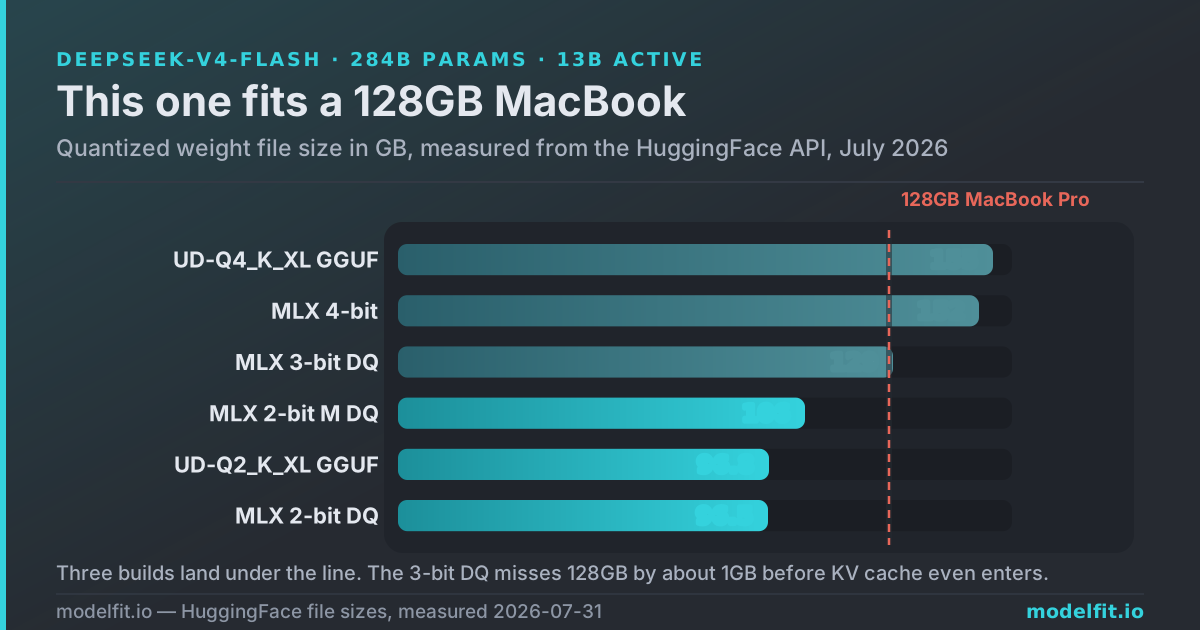
The FP8-mixed original is far too big for any Mac, but the quant ladder comes down to 96.5GB. These are measured file sizes from the HuggingFace API on July 31, 2026, not bytes-per-parameter estimates:
| Build | Format | Measured size | Fits 128GB? |
|---|---|---|---|
| UD-Q4_K_XL | GGUF (llama.cpp) | 155.1GB | No |
| MLX 4-bit | MLX | 151.5GB | No |
| MLX 3-bit DQ | MLX | 129.1GB | No, misses by 1.1GB |
| MLX 2-bit M DQ | MLX | 106.0GB | Yes |
| UD-Q2_K_XL | GGUF (llama.cpp) | 96.8GB | Yes |
| MLX 2-bit DQ | MLX | 96.5GB | Yes |
| UD-IQ1_S | GGUF (llama.cpp) | 82.5GB | Yes, quality floor |
DQ stands for dynamic quantization: the mlx-community builds pack most routed MoE expert weights to 2-bit while keeping sensitive layers and projections at 4, 6, or 8-bit (mlx-community, 2026). That policy is why a nominal 2-bit build lands at 96.5GB instead of collapsing quality across the board.
One honesty note: the MLX DQ conversions on HuggingFace today were made from the preview weights. Since DeepSeek confirms 0731 has the same architecture and size, 0731 conversions should land within about 1GB of these figures. Unsloth and bartowski already have 0731 GGUF repos uploading.
Does it actually fit a 128GB MacBook Pro?
Yes, with configuration. A 96.5GB model on a 128GB machine leaves roughly 30GB for the KV cache, macOS, and your apps. Out of the box, macOS caps GPU-addressable wired memory below what this model needs, so you raise the limit with sysctl iogpu.wired_limit_mb before loading. This is standard practice for large models on Apple Silicon and it is the difference between the model loading or failing.
Context is the real constraint. The model supports 1M tokens, but a 1M-token KV cache does not fit in 30GB of headroom. Plan on running tens of thousands of tokens of context, not hundreds of thousands. The V4 architecture helps here: DeepSeek's hybrid attention design cuts KV cache to a fraction of what V3.2 needed at the same context length (DeepSeek model card, 2026). Our context memory guide covers the KV cache math in detail.
The 3-bit DQ build at 129.1GB is the painful one. It misses the 128GB line by about 1GB before the KV cache even enters, so it is really a 192GB-class build.
How fast does it run on a Mac?
Fast enough for real work, per the first named measurements. Salvatore Sanfilippo (antirez) published single-run numbers for his ds4 inference engine, a dedicated DeepSeek 4 Flash and Pro engine for Metal, CUDA and ROCm that has already collected over 19,000 GitHub stars (antirez/ds4, 2026):
| Machine | Quant | Prefill | Generation |
|---|---|---|---|
| MacBook Pro M5 Max, 128GB | Metal | 790.18 t/s | 39.35 t/s |
| MacBook Pro M3 Max, 128GB | q2 | 58.52 t/s | 26.68 t/s |
| Mac Studio M3 Ultra, 512GB | q4 | 78.95 t/s | 35.50 t/s |
| DGX Spark GB10, 128GB | q2 | 825.76 t/s | 18.05 t/s |
Short-prompt figures shown for the M5 Max; the M3 Max and Studio rows are at 2,048-token context. These are single-run, greedy-decoding numbers from one engine, not a controlled benchmark, and antirez updates the README as the engine matures (the figures here reflect the August 2026 state). Still, the shape is clear: the 13B-active MoE design decodes at chat speed on a laptop, and a 128GB MacBook Pro roughly doubles the DGX Spark's generation rate on the same model.
One caveat on the DSpark speculative decoding module that ships with 0731. DeepSeek reports 57-85% faster per-user token delivery from DSpark on its own production serving stack (DeepSeek blog, 2026). DSpark is no longer a server-only win: on August 2, 2026, llama.cpp merged the module with the draft model published at am17an/DeepseekV4-Flash-20260731-DSpark, and the pull request measures about 50% faster code generation with --spec-draft-n-max 2 (PR #25784, 2026). On Apple Silicon, the original M2 Max replication still ran slower because that draft was only about 3.5x faster than the target. Check whether your engine ships the trained draft before expecting the server-side numbers.
How good is it?
By DeepSeek's own published numbers, 0731 is within striking distance of frontier closed models on agentic work. All figures below come from DeepSeek's benchmark table, so treat them as vendor-reported until independent runs land:
| Benchmark | V4-Flash-0731 | V4-Flash Preview | GLM-5.2 | Opus-4.8 |
|---|---|---|---|---|
| Terminal Bench 2.1 | 82.7 | 61.8 | 81.0 | 85.0 |
| DeepSWE | 54.4 | 7.3 | 46.2 | 58.0 |
| Toolathlon-Verified | 70.3 | 49.7 | 59.9 | 76.2 |
| Cybergym | 76.7 | 38.7 | - | 83.1 |
| Agents' Last Exam | 25.2 | 15.8 | 23.8 | 25.7 |
Source: DeepSeek-V4-Flash-0731 model card, 2026.
Two things stand out. First, the jump from preview is enormous: DeepSWE went from 7.3 to 54.4 on the same weights re-post-trained. Second, the remaining gap to Opus 4.8 is small on terminal-driving tasks (82.7 vs 85.0) and wider on repository-scale coding (NL2Repo: 54.2 vs 69.7). A 13B-active model you can hold on a laptop is not supposed to be in this table at all.
Remember these scores were produced on DeepSeek's own harness at full precision. A 2-bit quant on a MacBook will give some of that back, and nobody has published quantized benchmark runs yet.
How can you run it today?
Three paths work right now, and one popular path does not:
- MLX (Apple Silicon):
pip install mlx-lm, then loadmlx-community/DeepSeek-V4-Flash-2bit-DQ. This is the 96.5GB build from the chart. - ds4: antirez's dedicated DeepSeek 4 engine for Metal, CUDA and ROCm, source of the speed table above. It also runs the 1.6T V4-Pro on a 512GB Mac Studio at 2-bit (antirez/ds4, 2026).
- llama.cpp: GGUF support is live, and DSpark speculative decoding landed in mainline on August 2, 2026, about 50% faster on code workloads with
--spec-draft-n-max 2(PR #25784, 2026). ggml-org publishes official GGUFs and Unsloth's dynamic quants have six figures of downloads (Unsloth GGUF repo, 2026). LM Studio picks these up too. - Ollama: not yet. No
deepseek-v4-flashtag resolves in the registry as of August 9. When one lands, it shows up in our live dataset.
This is the reverse of the Kimi K3 situation from four days ago: K3's llama.cpp pull request is still unmerged, so its weights exist but do not run on consumer stacks. V4-Flash walked in with the runtimes already working, because the preview shipped months of tooling ahead of GA.
What hardware does this actually take?
Disclosure: the Amazon links in this section are affiliate links. ModelFit earns a commission if you buy, at no extra cost to you.A 128GB MacBook Pro (M4 Max or M5 Max) is the cleanest consumer machine for the 96.5GB build, and thanks to the DRAM shortage it is also the largest-memory Mac Apple currently sells new: the Mac Studio now tops out at 96GB after Apple retired the 256GB and 512GB tiers. Owners of earlier 192GB and 256GB Studios get the 3-bit and 4-bit builds too.
On the PC side, AMD's Strix Halo platform is the budget entry, with 128GB boxes like the GMKtec EVO-X2. Lucebox, which sells Ryzen AI MAX+ 395 boxes, reports the preview model reaching up to 32 tok/s decode with 128GB unified memory (Lucebox, 2026). That is a vendor's own number for its own hardware, but it lands in the same band as antirez's measured Mac figures above: the 13B-active MoE design keeps decode usable on every 128GB-class machine.
For everything below 82GB of memory, this model is out of reach. The general ladder still applies: 8GB runs 7-8B models, 16GB runs 13-14B, 32GB runs 27-32B, 64GB runs 70B-class quants. Check what your exact machine runs with the modelfit wizard or npx @wecko-ai/modelfit in a terminal, and see how open models stack up against cloud flagships on our benchmark leaderboard.
FAQ
Can I run DeepSeek-V4-Flash on a 64GB Mac?
No. The smallest real build is the 82.5GB UD-IQ1_S GGUF, and 1-bit quants of a 284B model carry a real quality penalty. On 64GB, strong MoE models like Qwen3.6 35B-A3B or 70B-class dense quants remain the practical ceiling. The RAM sizing guide maps every tier.
Is DeepSeek-V4-Flash available on Ollama?
Not as of August 9, 2026. No tag resolves in the Ollama registry. MLX and llama.cpp are the working paths today, and LM Studio can load the GGUF builds. Ollama support typically follows within days to weeks once GGUFs are stable.
How fast does DeepSeek-V4-Flash run on a MacBook Pro?
About 39 tok/s generation on a 128GB M5 Max and 27 tok/s on a 128GB M3 Max, per antirez's ds4 engine README, using short prompts and greedy decoding. The M5 Max row reflects the engine's August 2026 Metal path. At 65,536 tokens of context the M5 Max still generates at 27.64 t/s. These are single-run figures from one engine, not a controlled benchmark.
Is it really as good as Claude Opus 4.8?
Close on agentic benchmarks, behind on others, by DeepSeek's own numbers: 82.7 vs 85.0 on Terminal Bench 2.1, but 54.2 vs 69.7 on NL2Repo. Those scores come from full-precision serving on DeepSeek's harness. Quantized to 2-bit on a laptop, expect some regression. Independent quantized runs have not been published yet.
What does DQ mean in the model names?
Dynamic quantization. Instead of one bit-width everywhere, the mlx-community DQ builds keep most MoE expert weights at 2-bit while sensitive layers stay at 4, 6, or 8-bit. That is how the 96.5GB build keeps quality closer to the 151.5GB 4-bit build than a naive uniform 2-bit quant would.
Does the 1M-token context work on a Mac?
The model supports it, the memory does not. After a 96.5GB model loads on a 128GB machine, about 30GB remains for KV cache and the OS. That supports tens of thousands of context tokens comfortably. For 1M-token workloads, you need server hardware or the DeepSeek API, where V4-Flash-0731 is already the default deepseek-v4-flash model.
Sources
- DeepSeek-V4-Flash-0731 model card, HuggingFace: https://huggingface.co/deepseek-ai/DeepSeek-V4-Flash-0731
- DeepSeek-V4-Flash preview model card, HuggingFace: https://huggingface.co/deepseek-ai/DeepSeek-V4-Flash
- DeepSeek API changelog, 2026-07-31 entry: https://api-docs.deepseek.com/updates/
- HuggingFace model API, file sizes measured July 31, 2026: https://huggingface.co/api/models/mlx-community/DeepSeek-V4-Flash-2bit-DQ
- mlx-community 2-bit DQ build: https://huggingface.co/mlx-community/DeepSeek-V4-Flash-2bit-DQ
- Unsloth dynamic GGUF quants: https://huggingface.co/unsloth/DeepSeek-V4-Flash-GGUF
- ggml-org official GGUF: https://huggingface.co/ggml-org/DeepSeek-V4-Flash-GGUF
- DeepSeek announcement on X, July 31, 2026: https://x.com/deepseek_ai/status/2083084415157022911
- DeepSeek API pricing: https://api-docs.deepseek.com/quick_start/pricing
- llama.cpp, DeepSeekV4 MTP and DSpark support, merged August 2, 2026: https://github.com/ggml-org/llama.cpp/pull/25784
- am17an, DeepSeek-V4-Flash-0731 DSpark draft model, HuggingFace: https://huggingface.co/am17an/DeepseekV4-Flash-20260731-DSpark
- antirez, ds4 inference engine with Apple Silicon speed table: https://github.com/antirez/ds4
- DeepSeek, DSpark speculative decoding: https://deepseek.ai/blog/deepseek-dspark-speculative-decoding
- Jun Song on X, July 31, 2026: https://x.com/jun_song/status/2083089144818114968
- Hacker News, DeepSeek-V4-Flash Update: https://news.ycombinator.com/item?id=49119559
- Lucebox, DeepSeek V4 Flash on Ryzen AI MAX+ 395: https://www.lucebox.com/blog/deepseek-v4-strix-halo
Match this model to a machine that can run it: by RAM tier for Apple Silicon, or by VRAM for an NVIDIA GPU.
The weekly local-AI refresh
New open-weight models, real Apple Silicon benchmarks, and the one model worth running on your Mac this week. Free, one email a week, unsubscribe anytime.
By subscribing you agree to our Privacy Policy and to receive the weekly email. Unsubscribe anytime.
Have questions? Reach out on X/Twitter