01
Gemma 4 E4B (Q8)
Gemma / 4.5B / Q8_0 / ~7.5 GB
Best for: On-device, Mobile, Chat·Pop: 82/100
Perf: ~52 tok/s · first token ~0.4s
Local OKExcellentA · 48
Fits in 16 GB VRAM with room to spare. Best for on-device, mobile, chat on RTX 5060 Ti.
The RTX 5060 Ti brings GDDR7 memory and Blackwell architecture to the budget segment. At 51 tokens per second with 8B models, it outperforms the older 4060 Ti by 50% while offering the same 16GB VRAM capacity for 14B models.
The best local LLM for the RTX 5060 Ti is Gemma 4 E4B (Q8) at ~52 tok/s on its 16GB VRAM. It uses ~7.5GB of VRAM; the RTX 5060 Ti handles up to 14B parameter models at Q4. A 14B model at Q4 runs at ~32 tok/s. (ModelFit, 2026)
Sizing rule: a Q4 model needs about 0.6 GB of VRAM per billion parameters, and ModelFit budgets 90% of this card's 16GB for weights, context, and KV-cache. The per-size table below uses that same budget. Other strong fits: Qwen3.5 9B Instruct (Q8) (9B, ~10.7GB) and Qwen3 8B (Q8) (8B, ~8.1GB). Gemma 4 E4B (Q8) runs at an estimated 52 tok/s on this card. What it will not run: a 32B model does not fit in VRAM alone, so it spills to system RAM over PCIe and slows sharply.
Speeds are ModelFit estimates from memory bandwidth and model size, not measured benchmarks.
Cite this page: ModelFit, RTX 5060 Ti 16GB for Local LLMs: Runs 14B Q4 (~32 tok/s), https://modelfit.io/gpu/rtx-5060-ti/, updated September 2026, CC BY 4.0.
Last updated: September 15, 2026 · Editor: ModelFit Team
| Model Size | Est. Speed | Fit on 16GB |
|---|---|---|
| 7B | ~57 tok/s | Fits in VRAM |
| 14B | ~32 tok/s | Fits in VRAM |
| 20B MoE (3.6B active) | ~49 tok/s | Fits in VRAM |
| 32B | ~3 tok/s | CPU offload (slow) |
| 35B MoE (3B active) | ~31 tok/s | CPU offload (slow) |
| 70B | ~1 tok/s | CPU offload (slow) |
| 120B MoE (5.1B active) | ~7 tok/s | CPU offload (slow) |
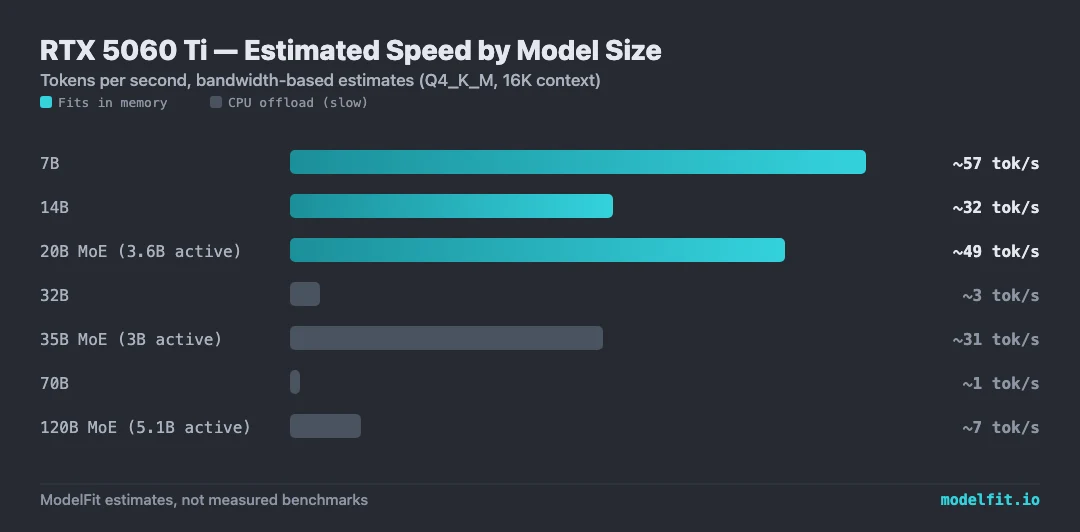
ModelFit estimates, not measured benchmarks: anchored to an 8B-class Q4_K_M model at 16K context on the RTX 5060 Ti's 448 GB/s bandwidth, then scaled by model size. MoE rows scale by active parameters (decode reads only the active experts), so a 35B MoE runs far faster than a dense 32B. "CPU offload" sizes exceed the 16GB VRAM; dense models slow to a crawl there, MoE models degrade less because hot experts stay GPU-resident.
Context costs VRAM too. Gemma 4 E4B (Q8) loads ~7.5 GB of weights; at 16k context the KV cache adds ~2.0 GB (still fits the ~14 GB usable VRAM), and at 64k it adds ~8.0 GB (exceeds the budget, use a smaller quant or a q8_0 KV cache).
The model leaves about 4.9 GB of the usable VRAM budget free after weights and 16k context.
KV-cache figures assume an fp16 cache, the llama.cpp/Ollama default. Standard GQA models use a size-class estimate (8 KV heads x 128 head dim class); hybrid linear-attention models (Qwen3.5/3.6, Qwen3-Next) use the exact per-token cost from their published config, since only their sparse full-attention layers cache KV. A q8_0 KV cache roughly halves either figure. Estimates, not measurements.
A Gen4 M.2 drive keeps your whole GGUF and quant collection on fast local storage, loading models straight off NVMe.
Check price on Amazon40Gbps external storage fast enough to run models from. Pair it with an M.2 drive for a portable model vault.
Check price on AmazonModelFit may earn a commission on purchases through these links, at no extra cost to you. Prices shown are approximate street references.
16GB GDDR7 at 448 GB/s gives the 5060 Ti a significant advantage over the 4060 Ti. The same 14B models that run at an estimated 21 tok/s on the older card now hit ~32 tok/s. You can load DeepSeek-R1 14B or Qwen 2.5 14B with 5-6GB to spare for KV cache. GDDR7 also improves batch throughput, making the 5060 Ti viable for light multi-user serving.
| Hardware | Memory | Speed | Bandwidth | Price |
|---|---|---|---|---|
| RTX 4060 Ti | 16 GB | 34 tok/s | 288 GB/s | $599 |
| RTX 3060 | 12 GB | 42 tok/s | 360 GB/s | $599 |
| RTX 5060 Ti | 16 GB | 51 tok/s | 448 GB/s | $685 |
| RTX 5070 | 12 GB | 59 tok/s | 672 GB/s | $788 |
Gemma / 4.5B / Q8_0 / ~7.5 GB
Best for: On-device, Mobile, Chat·Pop: 82/100
Perf: ~52 tok/s · first token ~0.4s
Fits in 16 GB VRAM with room to spare. Best for on-device, mobile, chat on RTX 5060 Ti.
Qwen / 9B / Q8_0 / ~10.7 GB
Best for: Quality, Coding, Reasoning·Pop: 86/100
Perf: ~29 tok/s · first token ~0.5s
Fits in 16 GB VRAM with room to spare. Best for quality, coding, reasoning on RTX 5060 Ti.
Qwen / 8B / Q8_0 / ~8.1 GB
Best for: Chat, Coding·Pop: 88/100
Perf: ~32 tok/s · first token ~0.5s
Fits in 16 GB VRAM with room to spare. Best for chat, coding on RTX 5060 Ti.
Gemma / 12B / Q4_K_M / ~8 GB
Best for: Chat, Coding, Multimodal·Pop: 80/100
Perf: ~36 tok/s · first token ~0.4s
Fits in 16 GB VRAM with room to spare. Best for chat, coding, multimodal on RTX 5060 Ti.
Qwen / 14B / Q4_K_M / ~11 GB
Best for: Coding, Quality·Pop: 84/100
Perf: ~32 tok/s · first token ~0.5s
Fits in 16 GB VRAM with room to spare. Best for coding, quality on RTX 5060 Ti.
Gemma / 12B / Q4_K_M / ~9.5 GB
Best for: Chat, Quality·Pop: 76/100
Perf: ~36 tok/s · first token ~0.4s
Fits in 16 GB VRAM with room to spare. Best for chat, quality on RTX 5060 Ti.
Llama / 8B / Q8_0 / ~8 GB
Best for: Chat, Coding·Pop: 78/100
Perf: ~32 tok/s · first token ~0.5s
Fits in 16 GB VRAM with room to spare. Best for chat, coding on RTX 5060 Ti.
Mistral / 12B / Q4_K_M / ~9.5 GB
Best for: Chat, Translation·Pop: 78/100
Perf: ~36 tok/s · first token ~0.4s
Fits in 16 GB VRAM with room to spare. Best for chat, translation on RTX 5060 Ti.
DeepSeek / 7B / Q8_0 / ~7.5 GB
Best for: Reasoning, Coding·Pop: 68/100
Perf: ~35 tok/s · first token ~0.4s
Fits in 16 GB VRAM with room to spare. Best for reasoning, coding on RTX 5060 Ti.
Mistral / 12B / Q8_0 / ~12.1 GB
Best for: Chat, Translation·Pop: 78/100
Perf: ~22 tok/s · first token ~0.5s
Fits in 16 GB VRAM with room to spare. Best for chat, translation on RTX 5060 Ti.
The RTX 5060 Ti tops out around up to 14b parameter models. For anything bigger, an hourly rented GPU runs the same open weights with the same Ollama workflow, billed by the hour, no hardware purchase needed.
ModelFit may earn a commission on sign-ups made through these links, at no extra cost to you.
Alibaba Cloud: Widest size range (0.5B to 235B)
LlamaMeta: Most popular open-weight model family
DeepSeekDeepSeek AI: Best-in-class reasoning with R1 models
MistralMistral AI: Excellent performance-per-parameter ratio
GemmaGoogle DeepMind: Excellent quality at small sizes (1B-9B)
PhiMicrosoft: Best quality-per-gigabyte at small sizes
The RTX 5060 Ti has 16GB GDDR7 VRAM with 448 GB/s bandwidth. About 15.5GB is usable for model loading. The GDDR7 memory is 55% faster than the GDDR6 in the 4060 Ti, directly boosting inference speed.
Up to 14B parameter models at Q4 quantization, same as other 16GB cards. The difference is speed: the 5060 Ti processes tokens 50% faster than the 4060 Ti thanks to GDDR7 bandwidth.
Yes, if you want 14B models. The 5060 Ti offers 4GB more VRAM (16 vs 12GB) and 24% more bandwidth (448 vs 360 GB/s). For 7B-only workloads, the cheaper RTX 3060 is still excellent value.
The RTX 5070 (12GB GDDR7) is faster with 8B models (~59 tok/s est.) but has 4GB less VRAM. Choose the 5060 Ti for 14B models, or the 5070 for maximum speed with 7B-9B models.
The RTX 5060 Ti's 16GB of VRAM cannot fit a 32B model comfortably. The largest size class it fits is 20B MoE (3.6B active), at an estimated 49 tok/s. The largest individual model in the catalog that fits is LFM2 24B-A2B Instruct (24B).
New open-weight models, real Apple Silicon benchmarks, and the one model worth running on your Mac this week. Free, one email a week, unsubscribe anytime.
By subscribing you agree to our Privacy Policy and to receive the weekly email. Unsubscribe anytime.
Use our interactive wizard to compare models across Apple Silicon and NVIDIA GPUs.