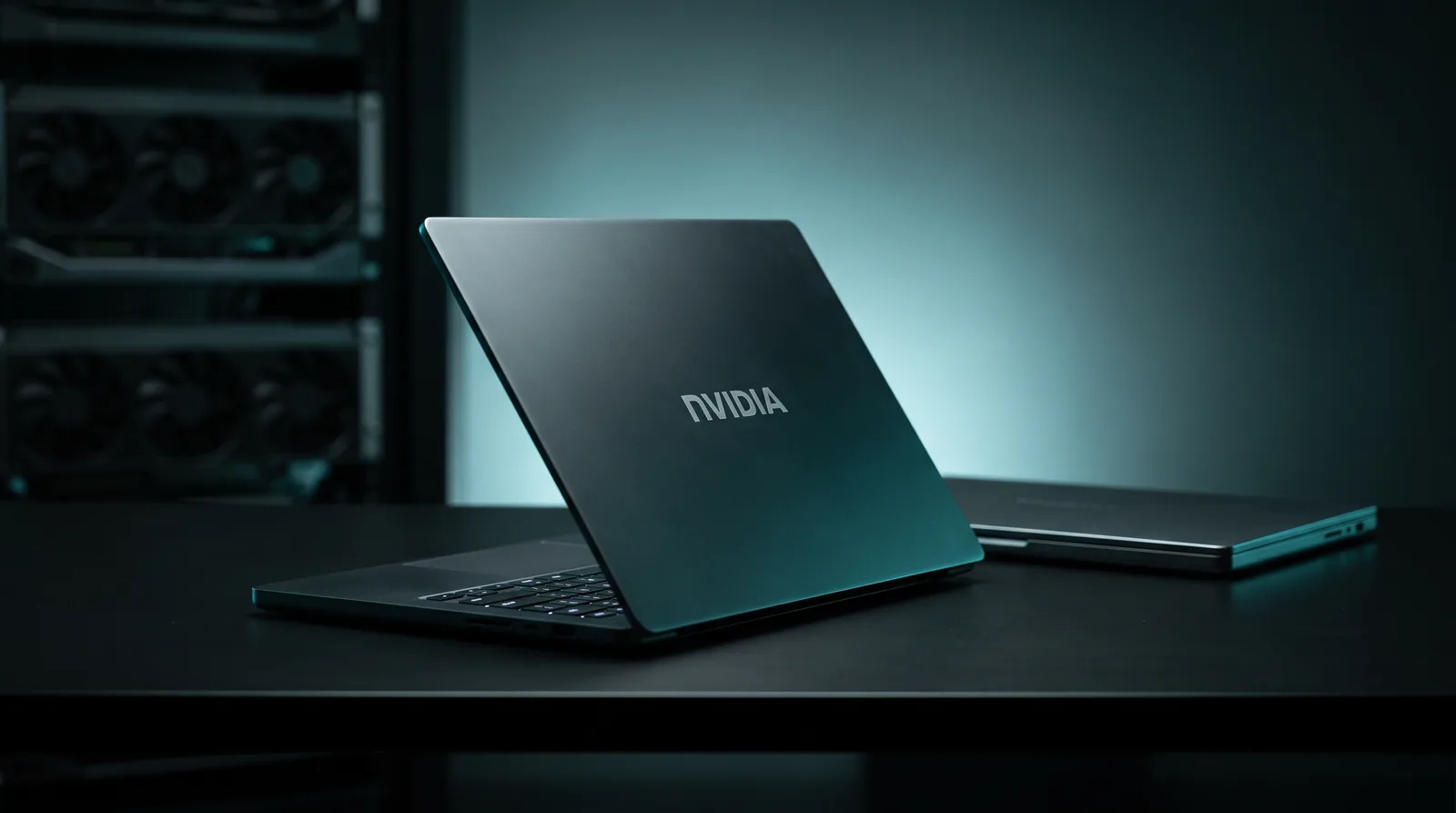
NVIDIA RTX Spark laptops go on sale Friday, October 16, and the number Mac owners will recognise is the memory ceiling: up to 128GB of unified LPDDR5X, the same ceiling as the top M5 Max configuration of the Mac Studio (NVIDIA Local AI blog, October 13, 2026). NVIDIA names Qwen 3.8 Flash Next, a 125B model, as a workload that runs locally on the machine. That model does fit the 128GB configuration, but only in a compressed 4-bit build: the shards of UD-IQ4_XS in the unsloth GGUF repository total 93,682,584,224 bytes, about 94 GB, while the UD-Q4_K_XL build totals 111,334,654,784 bytes and does not fit. Nothing in this article was run on RTX Spark hardware. Every figure below comes from a vendor page or a file listing, and where NVIDIA publishes nothing, this article says so.
The 64GB configuration is the other half of the answer. No build of Qwen 3.8 Flash Next fits there at all, because the smallest quantised build in the same repo is 72,546,461,344 bytes, about 73 GB, before any context or system overhead. If you want a 125B model on your desk this month, the memory floor is 128GB on either platform. What differs is the software stack, and the fact that NVIDIA publishes no memory bandwidth figure for the chip, which makes any tokens-per-second comparison a guess rather than a comparison.
Does it run on your machine? The 125B answer first
Unified memory is one pool of LPDDR5X that the CPU and the GPU address together, instead of a small dedicated VRAM pool beside a large system RAM pool. Capacity is what decides which models load at all, so capacity is where this comparison has to start.
Sizes below are the summed shard sizes of each quantisation folder in the unsloth Qwen3.8-Flash-Next-GGUF repository, read from the Hugging Face file listing on October 14, 2026. They are decimal GB (1 GB is 1,000,000,000 bytes), and they exclude the optional MTP draft model (4,137,429,120 bytes) and the vision projector mmproj-F16.gguf (904,004,000 bytes), which llama.cpp needs only for multimodal input and speculative decoding.
| GGUF build | Shard files | Total bytes | About | Fits 64GB | Fits 128GB |
|---|---|---|---|---|---|
UD-Q8_0 | 6 | 188,225,033,248 | 188 GB | No | No |
UD-Q6_K_XL | 6 | 169,165,382,688 | 169 GB | No | No |
UD-Q5_K_XL | 6 | 158,286,406,650 | 158 GB | No | No |
UD-Q4_K_XL | 4 | 111,334,654,784 | 111 GB | No | No |
UD-IQ4_XS | 3 | 93,682,584,224 | 94 GB | No | Yes, tight |
UD-Q3_K_XL | 3 | 89,986,353,824 | 90 GB | No | Yes |
UD-IQ3_XXS | 3 | 81,961,823,936 | 82 GB | No | Yes |
UD-Q2_K_XL | 3 | 78,869,128,864 | 79 GB | No | Yes |
UD-IQ1_M | 3 | 74,538,755,776 | 75 GB | No | Yes |
UD-IQ1_S | 3 | 72,546,461,344 | 73 GB | No | Yes |
Get told when a better model fits your RTX 4090
One email when a new open-weight model is a better fit for your machine, plus the Thursday weekly.
For: RTX 4090
Read the last column as our call, not as a vendor statement. We derived it from the shard sizes in that listing and from the memory budget our own recommendation engine applies to this model. That engine treats the full-precision UD-Q4_K_XL load as a 192GB-class job, and puts the UD-IQ4_XS build just inside a 128GB machine once the KV cache and the operating system take their share. Quantisation is the trade of numeric precision for file size, and it never is free. The IQ1 builds are a 1-bit class compression of a 125B model, so treat their output quality as unproven until someone publishes an evaluation.
The 125B figure is worth reading carefully, because NVIDIA's own wording invites a mistake. The October 7 preorder post calls it "a 125B model with 51B n-gram" (NVIDIA). The model card says 125B with 6B activated, plus a 51B n-gram embedding table and a 4B multi-token-prediction layer (Qwen). The 51B is an embedding table, not 51 billion active parameters per token. A mixture-of-experts (MoE) model is one that stores many expert sub-networks and routes each token through a few of them, which is why a 125B model can decode at a speed closer to a small dense model. That embedding table is also the reason the files are large: it has to be resident, and it is what pushes the smallest build to 73 GB.
What NVIDIA actually announced
Two laptop configurations and one desktop, all on the same superchip family, per NVIDIA's product page and the two launch posts:
| Configuration | GPU | CPU | Memory | Power |
|---|---|---|---|---|
| RTX Spark N1X, laptop | 6,144-core Blackwell RTX | 20-core Grace | Up to 128 GB LPDDR5X | 45 to 80 W |
| RTX Spark N1X, laptop | 5,120-core Blackwell RTX | 18-core Grace | Up to 64 GB LPDDR5X | 45 to 80 W |
| RTX Spark N1X, desktop | 6,144-core Blackwell RTX | 20-core Grace | Up to 128 GB LPDDR5X | 140 W |
The headline claims NVIDIA repeats on every page are 1 petaflop of FP4 AI performance, up to 6,144 GPU cores, up to a 20-core Grace CPU, and up to 128GB of unified memory (NVIDIA product page). Systems come from Acer, ASUS, Dell, HP, Lenovo, Microsoft, MSI and Gigabyte, laptops on October 16 and compact desktops in November. NVIDIA lists no price on either page we read on October 14, and launch configurations differ per OEM.
Two models matter for local use. Nemotron 3.5 Bolt 74B-A9B is the one NVIDIA built for the platform: a 74B MoE with 9B active parameters, packed into 24GB with 2-bit quantisation. It releases Thursday, October 15, with llama.cpp, vLLM, Ollama, Unsloth and LM Studio support named in the launch post. The second is Nemotron 3.5 Bolt E4B 4GB, a small model for in-game and voice agents, releasing October 23. The first is the more interesting one here, because 24GB of weights on a 64GB machine is the comfortable case, and it is the argument for the cheaper configuration.
600 GB/s is not the memory bandwidth, and no number exists

The figure that will be quoted most often is 600 GB/s, from the sentence that says the GPU and the Grace CPU are "connected at 600 GB/s". On the pages we read, that is a chip-to-chip link between two dies, not the rate at which the memory pool feeds the GPU. NVIDIA publishes no memory bandwidth figure for RTX Spark at all: the product page's spec tables list cores, memory configuration, power and display support, and no bandwidth row.
That gap matters, because decode speed for a large model is bounded by how fast weights stream from memory. Apple publishes the numbers on its own spec pages: 460GB/s on the base M5 Max Mac Studio, 614GB/s with the 40-core GPU, and 1.2TB/s on the M5 Ultra (Apple). Those are vendor figures for a different architecture, and they are not a prediction of RTX Spark performance. They are simply the number that is missing on one side of the comparison.
Which is why this article gives you no tokens per second for RTX Spark, not even an estimate. There is no published measurement on this hardware from any independent source as of October 14, 2026, and a bandwidth-free estimate would be invented. Our engine's estimates on Apple Silicon, and the file sizes above, are the only honest inputs we have.
What the 64GB RTX Spark runs, and what it does not
The 5,120-core, 18-core-CPU, 64GB configuration is a capable machine with a clear ceiling. Model sizes below are the sizes the model's own ollama.com/library page lists, or NVIDIA's own figure for its model.
| Model | Type | Listed size | 64GB machine | 128GB machine |
|---|---|---|---|---|
| Nemotron 3.5 Bolt 74B-A9B | MoE, 9B active, 2-bit | 24 GB | Yes, with headroom | Yes |
| Qwen3-Next 80B-A3B | MoE, 3B active, Q4 | 50 GB | Yes | Yes |
| gpt-oss:120b | MoE, 5.1B active, MXFP4 | 65 GB | No | Yes |
| Llama 4 Scout | MoE, 17B active, Q4 | 67 GB | No | Yes |
Qwen 3.8 Flash Next, UD-IQ4_XS | MoE, 6B active, 4-bit | 94 GB | No | Yes, tight |
Qwen 3.8 Flash Next, UD-Q4_K_XL | MoE, 6B active, 4-bit XL | 111 GB | No | No |
So the 64GB tier is, by our reading, a 30B-class dense and 80B-MoE machine, and 120B-class MoE models need the 128GB tier. Consider a working setup as an example. A 50GB model on a 64GB machine leaves about 14GB for the KV cache, the browser and Windows itself. That is enough for chat and short agent runs, and not enough for a second model in memory. On the Mac side the same ladder exists: our 128GB Mac Studio M5 Max guide puts gpt-oss-120b, Qwen3.5 122B-A10B and Llama 4 Scout in the tier that fits, and our 48GB Mac mini M5 Pro guide shows where MoE models stop fitting. The general rule for weights versus runtime overhead is in how much VRAM for LLMs.
Windows adds a variable the Mac does not have. Apple's shared pool is addressable by the GPU by design, while on the NVIDIA side the split between what Windows hands to the GPU and what it keeps for the system is a driver and OS question. Microsoft's own page describes the arrangement in general terms, saying that up to 128 GB of unified memory "allows the pool of RAM to be dynamically allocated wherever your workloads need it most across CPU and GPU", and that the machine is "capable of running up to 120B parameter models locally" (Microsoft). Neither Microsoft nor NVIDIA publishes the GPU-addressable share as a number, so treat the 120B claim as a vendor statement, not a tested budget.
A Mac at 128GB: same ceiling, different stack
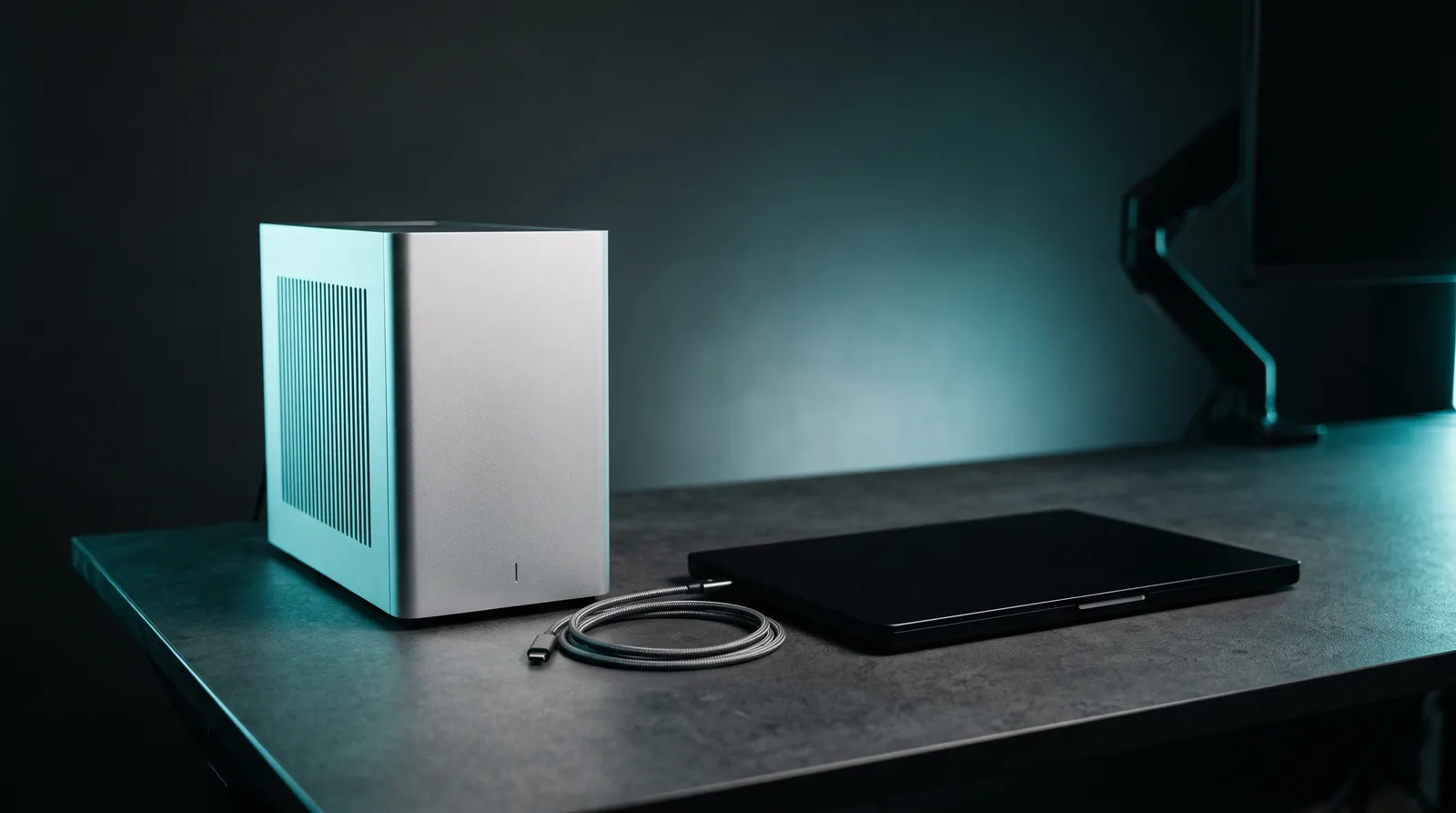
The capacity is a draw at the top of each range, so the decision moves to software and to what you already own.
- CUDA is the only accelerated stack on the NVIDIA side. NVIDIA's product page states that "CUDA, the software that accelerates the world's AI, runs natively on RTX Spark". The preorder post adds that developers can move workflows without rewriting, because it is the same NVIDIA stack from RTX Spark to DGX Station. There is no Metal path and no MLX path on that hardware.
- On a Mac the stack is Metal plus MLX, with llama.cpp and Ollama on top. The quantised GGUFs in the table above, such as
UD-IQ4_XS, run on either machine, and what changes is the runtime that executes them. - The agent ecosystem is where NVIDIA is spending its effort: setup screens for GitHub Copilot, Hermes, OpenClaw, Perplexity, Pi and WorkBuddy, sandboxing through OpenShell and Microsoft Execution Containers, and a local-or-cloud router called Switchyard. Apple's equivalent story is the compression and the unified pool, not an agent harness.
- The same 125B model already runs on Macs below 128GB, through disk streaming rather than memory. Our SlotStream walkthrough covers an engine that keeps a bounded set of experts in RAM and reads the rest from an SSD. That is how a 48GB MacBook Pro decodes Qwen 3.8 Flash Next at a usable rate once warm. That route is slow and disk-bound, and it is the reason a Mac owner does not need 128GB to touch this model class.
What the two machines cost
Microsoft's own product page lists the Surface Laptop Ultra at $2,599.99, and Apple's store page lists the Mac Studio from $2,499 (Microsoft, Apple). Those are entry prices, and neither entry machine carries 128GB. On Apple's side the M5 Max Mac Studio starts at 36GB and is configurable to 48GB, 64GB or 128GB; on NVIDIA's side 128GB is the top memory configuration of the 6,144-core N1X laptop and of the desktop, while the smaller 5,120-core N1X tops out at 64GB.
Memory parity therefore is not price parity, because both vendors charge a step-up for the 128GB class. This article quotes no price for a 128GB configuration on either side: NVIDIA publishes none, and the Mac side moves with chip and storage options. For the memory-shortage context behind current prices, see our DeepSeek-V4-Flash hardware cost guide, which tracks 128GB machines on both platforms.
FAQ
Is 600 GB/s the memory bandwidth of RTX Spark?No. The October 7 preorder post says the Blackwell RTX GPU and the Grace CPU are connected at 600 GB/s, which is the link between the two dies. NVIDIA publishes no memory bandwidth figure for RTX Spark, and its product page has no bandwidth row at all. Do not use 600 GB/s to estimate decode speed on this hardware.
Will Qwen 3.8 Flash Next run on the 64GB RTX Spark?Not in any build that exists today. The smallest quantised build in the unsloth repository is UD-IQ1_S at 72,546,461,344 bytes, about 73 GB, which is past a 64GB pool before the KV cache and the operating system. The 128GB configuration is the one that loads it, and UD-IQ4_XS at about 94 GB is the highest-precision build of the six that fit.
Capacity-wise, yes, and the Mac pool is shared with the GPU by design. macOS still takes its share, which our 128GB M5 Max guide budgets at about 109GB left for models. Run the same 4-bit GGUF or an MLX conversion and the weights fit inside that budget. What a Mac cannot do is run the CUDA-only paths NVIDIA is building its agent stack around, and NVIDIA's own bandwidth-free spec sheets mean neither machine has a published speed number to compare.
Is a 125B model a reason to buy RTX Spark now?Only if you need 128GB of unified memory on a Windows laptop today. Laptops ship October 16 and compact desktops in November, no independent measurement of the platform existed when this article was written, and NVIDIA lists no prices. If a 125B model is your goal and you already own an Apple Silicon Mac, the streaming route in our SlotStream guide runs the same weights today without new hardware.
Does this replace a Mac Studio M5 Ultra for local work?Not on capacity. The M5 Max Mac Studio tops out at 128GB and the M5 Ultra goes to 512GB with 1.2TB/s of published bandwidth, against a 128GB ceiling on RTX Spark. Our M5 Ultra 512GB guide covers what that extra memory buys. RTX Spark competes on portability and on CUDA, not on the largest local models.
Sources
- NVIDIA Local AI blog, RTX Spark launch software and ecosystem (October 13, 2026)
- NVIDIA RTX Spark product page and specifications
- NVIDIA and Microsoft RTX Spark preorder post (October 7, 2026)
- Microsoft Surface Laptop Ultra product page
- Microsoft Surface Laptop Ultra for Business page
- Qwen3.8-Flash-Next model card
- unsloth Qwen3.8-Flash-Next GGUF repository
- File listing with byte sizes for that GGUF repository
- Apple Mac Studio technical specifications
- Apple Store Mac Studio configuration page
- Ollama library, gpt-oss
- Ollama library, qwen3-next
- Ollama library, llama4
Don't miss the next one for your RTX 4090
This article covers one moment. Get one email when a newer open-weight model fits your machine better, plus the Thursday weekly with what changed.
For: RTX 4090
Match this model to a machine that can run it: by RAM tier for Apple Silicon, or by VRAM for an NVIDIA GPU.
Have questions? Reach out on X/Twitter