
A popular hardware checker, willitrunai.com, grades a 1-bit quantization of GPT-OSS 20B as an A-tier fit for a 16GB card, right next to its own label of "Very Low" quality. That single page explains why ModelFit lists sub-3-bit quants but never ranks them. We re-verified every claim in this post against their live site on September 12, 2026, and we sampled 80 of their verdict pages the same day. 61 of those 80 pages display a time to first token above 5 seconds, and 18 print the exact same figure: 96.8 seconds.
TL;DR: A quant below 3 bits trades away most of a model's reasoning for a smaller file, so ranking it as an A-tier choice is not a rounding error: it is a missing quality gate. On ModelFit, Q1 and Q2 class builds appear in our quant tables labeled "Experimental, not ranked, never recommended". This post shows what happens when a pipeline skips that gate, using willitrunai.com's own live pages as the evidence.
What does a popular hardware checker actually recommend?
Their verdict page for GPT-OSS 20B on an RTX 4060 Ti 16GB grades the Q1_0_G128 build an A with a score of 79, and the Q2_K build an A at 83. Their own table labels those same builds "Very Low" and "Low" quality (willitrunai.com, 2026). The quality warning and the grade sit in the same row, and the row still reads as a recommendation.
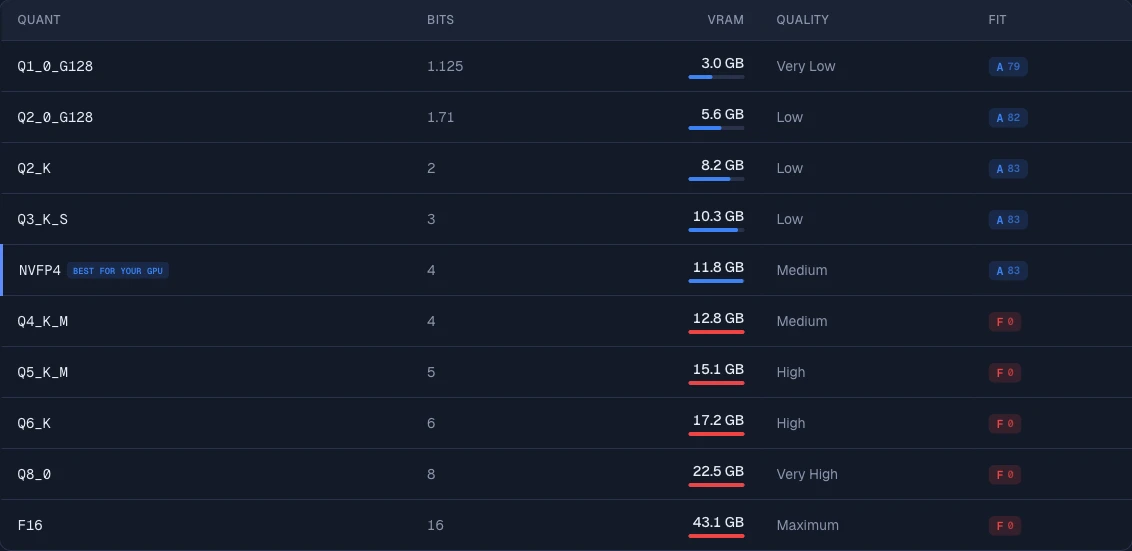
The same page recommends "1-bit Bonsai 27B" as one of the best models for that card, at grade A and 29.6 tok/s. A 1-bit build of anything is a research artifact, not a recommendation. Worse, the page grades a configuration its own interface calls "Very compromised" as an A for coding, then concludes "YES (18.1/16.0GB)": a yes verdict for 18.1 GB on a card with 16.0 GB. Would you buy a GPU on a yes that needs 2 GB more than the card has?
For contrast, our page for the exact same combo computes 13.8 GB of MXFP4 weights against 14.4 GB of usable VRAM. That is a grade B fit: tight, but honest, at ~56 tok/s est. with a first token around 0.4 s. We would rather hand you a B you can trust than an A your card cannot satisfy.
Is this one bad page or a pattern?
It is a pattern, and we sampled it rather than collecting anecdotes. On September 12, 2026 we drew 80 English can-run URLs at random from their sitemap, which holds 77,524 such pages, and we read the time to first token each one displays. Time to first token (TTFT) is the delay between submitting a prompt and seeing the first token of the reply, so a large TTFT means the user sits there waiting.
61 of the 80 sampled pages, 76% of the sample, show a TTFT above 5 seconds. In fact, 18 of them show the identical value 96.8 seconds, on combos with nothing in common: a 90M-parameter embedding model on an RTX 4060, a 671B mixture-of-experts model on a 6GB card, a datacenter B200. A formula that saturates prints a constant, and that is what a 96.8 s "time to first token" is.
The same scan surfaced embedding models (all-minilm-l6-v2, jina-embeddings-v3, wemm-embedding-2b) graded with chat metrics like TTFT and tok/s, even though embedding models do not generate tokens at all. Grading them on decode speed is a category error that any human reviewer catches in seconds, which tells you how much human review is happening.
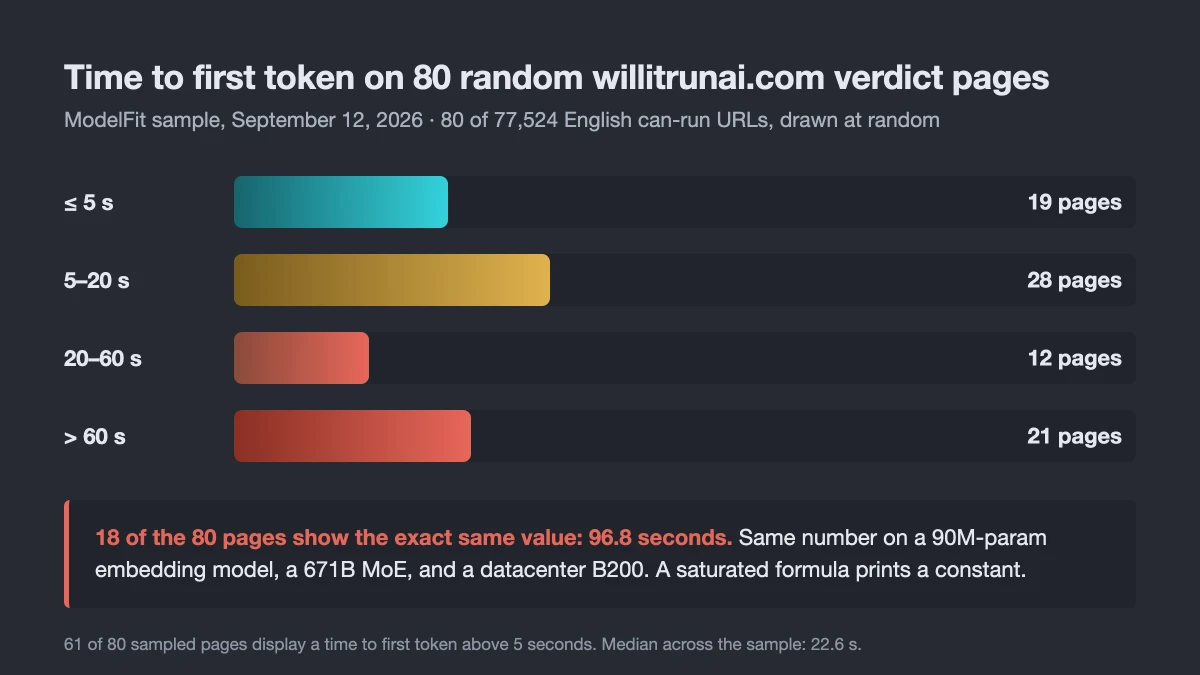
Still, the most revealing finding is the impossible yes. 3 of the 80 sampled pages answer YES while their own math exceeds the card. For example, Yi 1.5 9B "needs 9.0 GB" on an 8.0 GB RTX 4060, verdict yes, live today. One bad page is an accident, but at these rates you are looking at a pipeline with no quality gate.
Get told when a better model fits your MacBook Air M5 16 GB
One email when a new open-weight model is a better fit for your machine, plus the Thursday weekly.
For: MacBook Air M5 16 GB
You'll also get the weekly ModelFit email. By signing up you agree to our Privacy Policy. Unsubscribe from either email anytime, in one click.
What does their model catalog look like up close?
Their Kimi K3 page titles the model at 1708 GB, describes it in the body as "approximately 1750.4 GB", and recommends hardware with "at least 2013 GB" of VRAM (willitrunai.com, 2026). That is three different figures on one page, and the last one is an extrapolation no consumer machine can satisfy, printed as buying advice. The tenth of a GB in "1750.4" is precision theater on a 1.7 TB estimate.
Their GPT-OSS 20B page presents a "12.8GB Q4_K_M" as the reference build (willitrunai.com, 2026). Yet GPT-OSS 20B is natively MXFP4, and the community Q4_K_M build that actually exists is 11.7 GB (bartowski's HF repo, 2026). We documented the real numbers in our GPT-OSS 20B VRAM guide. Meanwhile, their changelog has not moved since March 2026. Their 82,888-URL sitemap also contains zero pages mentioning Apple M5 or M6 hardware, nine months after those chips shipped. As a result, every Mac buyer who lands there gets advice that is a hardware generation behind.
What actually happens below 3 bits?
Quantization is the compression of a model's weights to fewer bits per weight, trading quality for a smaller file and faster loads. You do not need to take our word for what that trade looks like below 3 bits, because their own table already tells you: next to the grade A, the quality column reads "Very Low" for Q1_0_G128 and "Low" for Q2_K. Below roughly 3 bits per weight, every public quantization study and every maintainer's guidance converge on the same outcome. Perplexity climbs sharply, instruction following degrades, and long-context behavior breaks first. Of course, a 2-bit build can still be the right answer for a demo or a memory-pressed experiment, but it is never an A-tier recommendation for daily use.
That is why the grade matters more than the listing. Grade inflation is what happens when a ranking formula rewards fit and speed but never checks output quality. Listing a junk quant with an honest warning serves the reader who knows what they are doing. Ranking it beside real builds, with a letter grade that says "great choice", only serves the page count.
What do we do instead?
ModelFit's rule is one sentence: sub-3-bit quants are listed, labeled, and never ranked. On our quant-compare tables you will find the same Q1 and Q2 builds they grade an A, grayed out with the note "Experimental, not ranked, never recommended". The builds we do rank are gated on two things: a real GGUF file we can weigh, and an Ollama registry tag we probed and found alive.
Everything downstream inherits that gate. Workload grades on our can-i-run pages come from fit percentage and registry metadata, not from a formula that can saturate into a constant. When a model does not fit, the page says so, even when the honest answer is "buy more RAM or pick a smaller model".
Where does ModelFit itself fall short?
Fair is fair, because a comparison post that hides its own limits is the same failure with better manners. Our tok/s figures are bandwidth-derived estimates, labeled "est." on every page, not measurements from hardware we own. Our catalog covers about 141 models against their 444 model pages, since every entry waits for a registry probe. And our hardware coverage is Apple-first, which is a real gap if you are pricing an AMD or Intel build.
We think those are the right trade-offs, because a smaller catalog with a gate beats a bigger one that recommends 1-bit quants at grade A. On the other hand, you should not take our word for it either: judge both sites on their numbers. Ours are public, and the same engine powers the homepage wizard, the dataset export, and the npx @modelfit/cli@latest CLI.
FAQ
Is Q2_K good enough for a 16GB GPU?
Q2_K is usable for experiments, but it should not be your daily build. On a 16GB card, Q4_K_M or Q5_K_M fits most 13B to 20B class models with far better quality per GB. If a site grades Q2_K an A while calling it "Low" quality in the same table, trust the quality label, not the grade.
Why does my hardware checker rank Q1_0 as grade A?
Because its ranking formula only weighs fit and speed, not output quality. A 1-bit build is small and fast, so a quality-blind formula scores it highly. Look for a quality gate instead: if the site never excludes a build from ranking, its grades are measuring the wrong thing.
What quantization should I actually use on 16GB?
For most models, Q4_K_M is the default answer, with Q5_K_M or Q6_K when you have headroom. Our quant-compare tool shows the exact weights, KV cache, and fit for each build of a model on your memory tier, with sub-3-bit options visible but excluded from the ranking.
Is willitrunai.com reliable?
Its coverage is wide and its tools are polished, but the defects above are structural, not cosmetic. As of September 12, 2026, 61 of 80 randomly sampled verdict pages showed a TTFT above 5 seconds, and 18 printed the identical 96.8 s value. Cross-check any verdict against a second source before you buy hardware on it.
Sources
- willitrunai.com: GPT-OSS 20B on RTX 4060 Ti 16GB verdict page (archived screenshots on file, re-verified September 12, 2026).
- willitrunai.com: Kimi K3 model page (re-verified September 12, 2026).
- willitrunai.com: GPT-OSS 20B model page (re-verified September 12, 2026).
- Hugging Face: bartowski/openai_gpt-oss-20b-GGUF file listing (Q4_K_M file size, September 12, 2026).
- ModelFit TTFT sample: 80 random English can-run URLs drawn from the willitrunai.com sitemap, September 12, 2026 (scripts/willitrunai-pattern-scan.mjs, raw output archived).
- ModelFit: GPT-OSS 20B on RTX 4060 Ti (our engine figures for the same combo).
Don't miss the next one for your MacBook Air M5 16 GB
This article covers one moment. Get one email when a newer open-weight model fits your machine better, plus the Thursday weekly with what changed.
For: MacBook Air M5 16 GB
You'll also get the weekly ModelFit email. By signing up you agree to our Privacy Policy. Unsubscribe from either email anytime, in one click.
Match this model to a machine that can run it: by RAM tier for Apple Silicon, or by VRAM for an NVIDIA GPU.
See how this changes your recommendation
Run the wizardHave questions? Reach out on X/Twitter