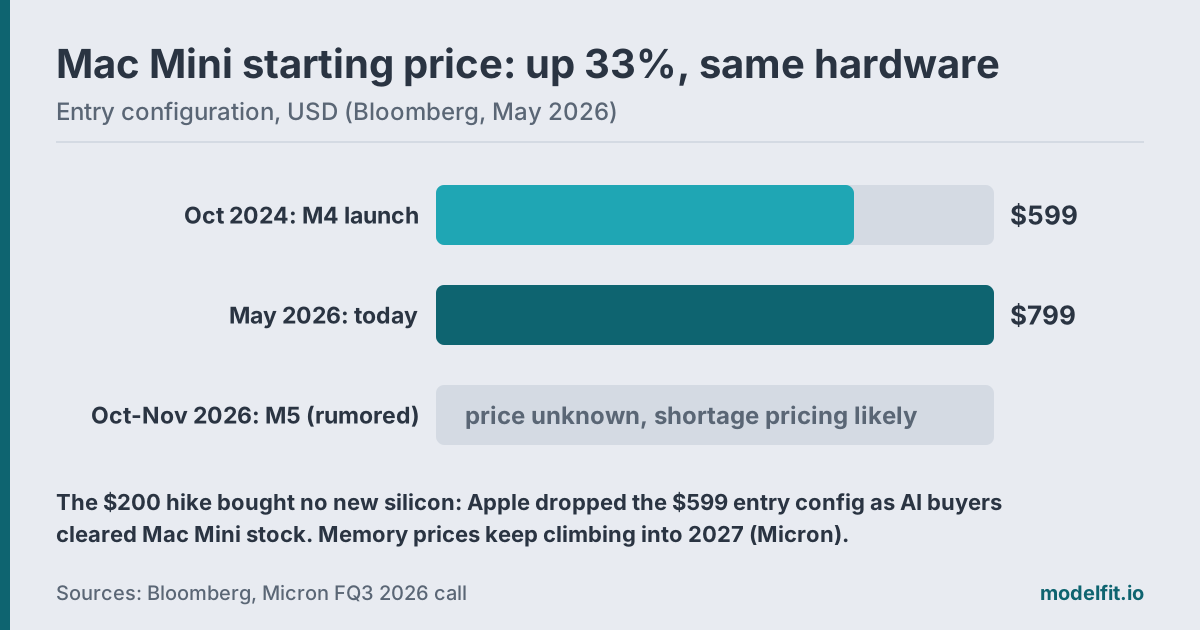
TL;DR: Buy the Mac Mini M4 now if you need a local AI machine this year. The entry price already jumped from $599 to $799 (Bloomberg, 2026), memory prices are still climbing, and the M5 mini is only a rumor for October or November. Wait only if you specifically want the M5's AI-focused GPU and can absorb launch pricing plus launch-day stock risk.
"Buy now or wait for the M5?" is the most asked Mac Mini question in local AI communities right now, and 2026 broke the usual answer. Normally you wait: a new chip is months away and prices hold. This year prices are moving against you while you wait. Apple raised the Mac Mini's starting price from $599 to $799 in May by discontinuing the entry configuration (Bloomberg, 2026), then raised prices across the Mac line in June. Here is the honest math.
Why did the Mac Mini get $200 more expensive?
Local AI demand emptied the shelves. Tim Cook said customers are "snapping up Mac minis and Mac Studios to run artificial intelligence" and that "the customer recognition of that is happening faster than what we had predicted" (Fortune, 2026). The Mac Mini became the default cheap box for running models at home, and Apple could not keep up.
The second force is the global memory shortage. TrendForce reported PC DRAM contract prices rising by over 100% quarter over quarter in early 2026 (TrendForce, 2026). That squeeze pushed Apple to a broader hike on June 25: the 13-inch MacBook Air went from $1,099 to $1,299, the 14-inch MacBook Pro from $1,699 to $1,999, and the Mac Studio from $1,999 to $2,499 (The Spokesman-Review, 2026). The Mac Mini took its hit early, in May, before the rest of the line.
And the squeeze has a long tail. Micron's CEO expects tight memory conditions "to persist beyond calendar 2027" (TechSpot, 2026). Waiting for prices to fall back to 2025 levels is not a plan.
What would the M5 Mac Mini actually add?
The M5 generation is a real step for local AI, not a routine bump. Apple's M5 introduces a Neural Accelerator in each GPU core and delivers over 4x the peak GPU compute performance for AI compared to the M4, plus 153GB/s of unified memory bandwidth, a nearly 30 percent jump over the M4's 120GB/s (Apple Newsroom, 2025). Bandwidth is the number that governs token generation speed, so a base M5 mini should decode meaningfully faster than a base M4 mini. Treat any exact tokens-per-second figure as an estimate until real units ship.
When does it arrive? Mark Gurman's 2026 Mac plan lists an M5 and M5 Pro Mac Mini (Gurman on X, 2025), and reporting points to an October or November launch (Macworld, 2026). None of it is Apple-confirmed, and the memory shortage has already slipped other 2026 Mac dates. For the bigger picture, Apple is reportedly skipping M6 Pro and Max chips entirely to fast-track the M7 (MacRumors, 2026); our Apple M7 roadmap breakdown covers what that means for local AI.
What does a Mac Mini M4 run today?
Everything most people actually use, right now. The RAM ladder is the whole decision:
| Config | Unified memory | Largest comfortable model (Q4, est.) |
|---|---|---|
| M4 base | 16GB | ~14B (Qwen3.5 9B is the sweet spot) |
| M4 | 24GB | ~27B |
| M4 | 32GB | ~32B |
| M4 Pro | 64GB | ~70B class |
Get told when a better model fits your Mac Mini M6 16 GB
New open-weight models land every week. When one beats today's pick on your exact machine, you get one short email: the model, why it is better, and the command to run it.
You'll also get the weekly ModelFit email. By signing up you agree to our Privacy Policy. Unsubscribe from either email anytime, in one click.
A 16GB M4 mini runs 7B to 9B models with room to breathe; our ranked picks are in the best LLMs for Mac Mini M4 16GB guide, with the 24GB tier covered separately. The full sizing math lives in the how much RAM for a local LLM guide, and the hardware calculator sizes a pick to any RAM or GPU. If you are weighing the Mini against a bigger box, see Mac Mini vs Mac Studio for LLMs.
The M4 is not the bottleneck for a 2026 local stack. Models have improved faster than chips: a modern 9B model now covers work that needed a far larger model two years ago. Your RAM tier decides what you can run; the chip decides how fast it feels.
So: buy now or wait?
Buy the M4 now if any of these apply. You need the machine before November. You want a 16GB or 24GB tier box for 7B to 14B models, where the M4 is already comfortable. Or your budget is fixed: memory-driven pricing means the M5's launch price is exposed to the same shortage that added $200 to the M4, and Micron sees tightness beyond 2027 (TechSpot, 2026). Today's $799 M4 could look cheap in retrospect.
Wait for the M5 if all of these apply. You do not need the machine before late 2026. You specifically want the neural-accelerator GPU for prompt processing and larger contexts. And you are ready to order on announcement day: Cook already flagged demand outrunning supply on current minis, so launch stock will be thin. If you wait, decide your RAM tier now with the ModelFit wizard so you can order the right config in the first minutes.
The trap to avoid is the middle path: waiting months and then buying more RAM than your target models need at shortage prices. Size the model first, then buy exactly that tier.
FAQ
When does the Mac Mini M5 come out?
October or November 2026 is the reported window. Gurman's 2026 Mac plan includes an M5 and M5 Pro Mac Mini, and Macworld points to an October launch. Apple has not confirmed a date, and the memory shortage has already delayed other 2026 Macs, so treat the window as a rumor.
Is the Mac Mini M4 still worth it at $799?
Yes, if you match the RAM tier to your models. At 16GB it runs 7B to 9B models comfortably and up to ~14B at Q4. The $200 hike hurts, but memory prices are still rising and the M5's pricing will face the same shortage. The M4 remains the cheapest capable local AI box Apple sells.
Will the Mac Mini M5 cost more than the M4?
Unknown, but the pressure is upward. Apple raised prices across the Mac line in June 2026 citing memory costs, and Micron expects tight supply beyond 2027. A return to a $599 entry Mac Mini looks unlikely in this cycle.
How much faster will the M5 be for local LLMs?
Apple's published M5 figures: over 4x the peak GPU compute for AI versus the M4 and 153GB/s of memory bandwidth versus 120GB/s, a nearly 30 percent gain. Token generation scales with bandwidth, so expect a similar order of decode speedup on the base chip. Exact tokens per second on a mini are estimates until units ship.
Should I buy the M4 Pro instead of waiting?
If you want 70B-class models, yes. The M4 Pro with 64GB runs them today, and no rumor gives the M5 mini more than incremental gains at that tier. The jump that matters for big models is RAM, not the chip generation.
Sources
- Bloomberg: Apple raises Mac Mini's starting price to $799 (May 2026)
- Fortune: Mac Mini price hike and Tim Cook on AI demand (May 2026)
- The Spokesman-Review (AP): Apple hikes Mac and iPad prices on memory shortage (June 2026)
- TrendForce: Memory price outlook for 1Q26 sharply upgraded (February 2026)
- TechSpot: Micron CEO expects memory shortages to stretch beyond 2027 (June 2026)
- Apple Newsroom: Apple unleashes M5 (October 2025)
- Mark Gurman: 2026 Mac plan (2025)
- Macworld: 2026 Mac Mini M5 and M5 Pro (2026)
- MacRumors: Redesigned MacBook Pro waits for M7 (July 2026)
Where to Buy for Local AI
best configsArchive your model library off the internal drive. Quantized models run 5 to 40GB each, so 2TB holds dozens with room to spare.
Check price on Amazon40Gbps external storage fast enough to run models from. Pair it with an M.2 drive for a portable model vault.
Check price on AmazonMore ports for the external drives, displays and peripherals around a local-AI workstation.
Check price on AmazonCheapest way into the 24GB sweet spot: runs 14B models comfortably and 30B MoE via mmap.
Check price at AppleMore headroomLoads 70B-class models and leaves room for a multi-model local stack.
Check price at AppleModelFit may earn a commission on purchases through these links, at no extra cost to you.
Have questions? Reach out on X/Twitter