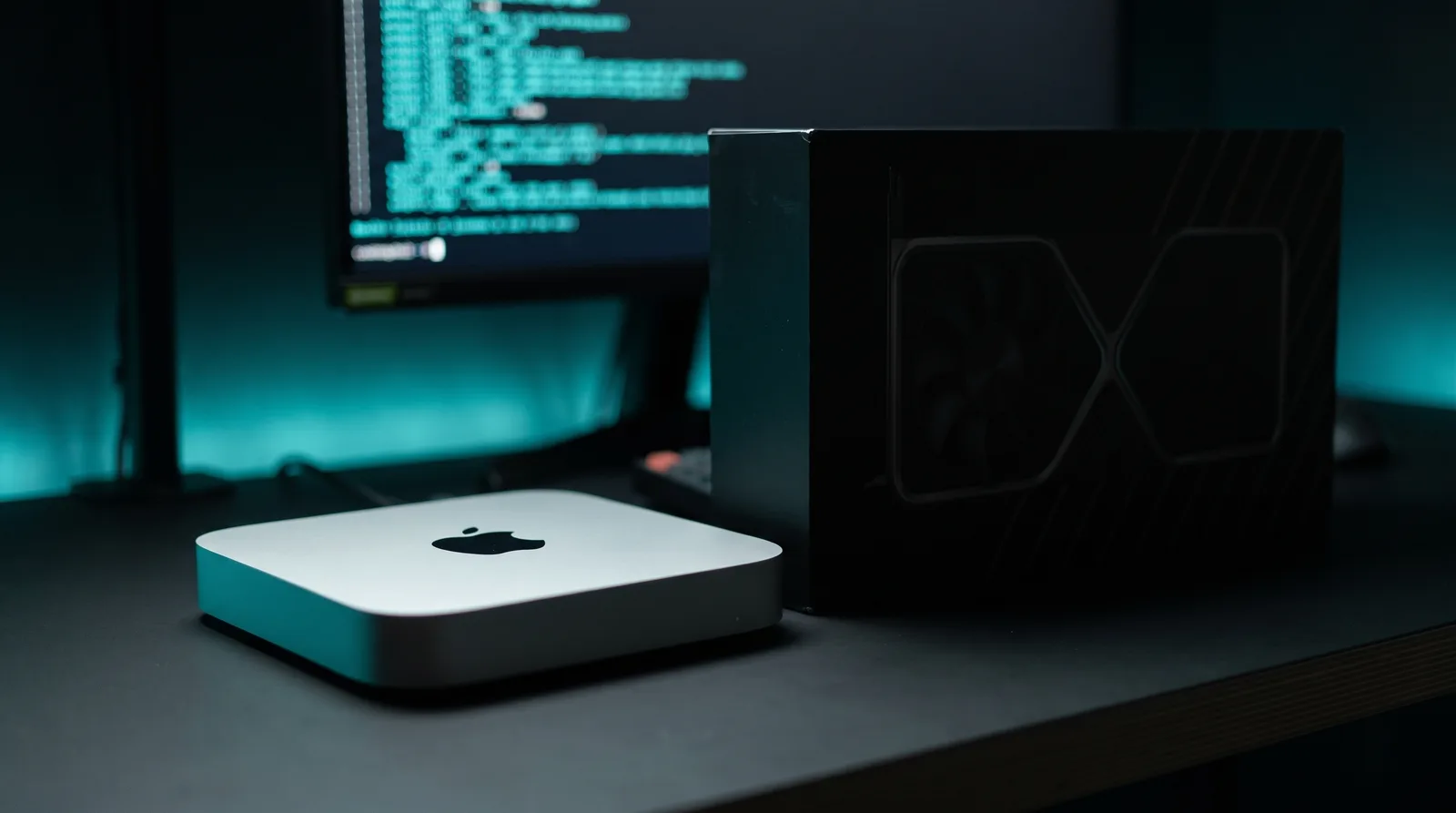
Apple announced the M6 Mac Mini on August 26, 2026, with shipping on September 22. The base config pairs a 12-core CPU and 12-core GPU with 16GB of unified memory at 153 GB/s for $899, and the 24GB/32GB tiers step up to 170 GB/s. The ModelFit engine's estimates for every config map RAM tiers to actual models. The short answer: the MoE wave makes this little box far more capable than its bandwidth suggests.
What the M6 actually changes
The M4 Mac Mini shipped with a 10-core CPU, 10-core GPU and 120 GB/s of bandwidth. The M6 moves to 12 CPU cores and 12 GPU cores, a dual 16-core Neural Engine, and 153 GB/s on the 16GB config. There was never an M5 Mac Mini: Apple skipped a generation on the base model, and the Pro option is now the M5 Pro.
| Config | RAM | Bandwidth | Price |
|---|---|---|---|
| M6 | 16GB | 153 GB/s | from $899 |
| M6 | 24-32GB | 170 GB/s | from $1,399 |
| M5 Pro | 24-64GB | 307 GB/s | from $1,699 |
Get told when a better model fits your Mac Mini M6 16 GB
One email when a new open-weight model beats these picks on your machine, plus the Thursday weekly.
For: Mac Mini M6 16 GB
You'll also get the weekly ModelFit email. By signing up you agree to our Privacy Policy. Unsubscribe from either email anytime, in one click.
Two cautions on the marketing numbers. Apple's "up to 4x faster" claim is measured against the M4 Pro on an ambiguous test, so we do not repeat it as fact. And Apple never publishes Neural Engine TOPS, so any TOPS figure you see online is inferred.
For LLM inference the core count mostly helps prompt processing. Token generation is bandwidth-bound, which is why the per-tier bandwidth matters more than the CPU count for chat speed.
What each RAM tier runs
Memory is the hard ceiling: weights plus KV-cache must fit in unified memory alongside macOS. A 14B Q4 model needs about 11GB for weights plus roughly 3GB of KV-cache at 16k context. Sparse MoE models change the math, because decode speed tracks active parameters while memory tracks total size.
| RAM | Top engine pick | Est. speed |
|---|---|---|
| M6 16GB | Qwen3.5 9B Instruct (Q4) | ~28 tok/s est. |
| M6 24GB | GPT-OSS 20B (21B MoE) | ~38 tok/s est. |
| M6 32GB | Gemma 4 26B-A4B (MoE) | ~38 tok/s est. |
| M5 Pro 48GB | Qwen3.6 35B-A3B (MoE) | ~99 tok/s est. |
| M5 Pro 64GB | Qwen3.6 35B-A3B (Q8) | ~60 tok/s est. |
The surprise is the 24GB tier. GPT-OSS 20B is a 21B-parameter model that behaves like a 3.6B model at decode time, so it runs faster on the M6 than the dense 9B pick while scoring higher on quality benchmarks. Two years ago a base Mac Mini meant 7B models. In 2026 it means 20B-class MoE.
The 32GB tier buys context and model size headroom rather than speed, since bandwidth stays at 170 GB/s. It is the right call if you run long documents or keep an embedding model loaded alongside your chat model.
M6 vs M5 Pro: when to step up
The M5 Pro doubles bandwidth to 307 GB/s and lifts the ceiling to 64GB. In our estimates it runs Qwen3.6 35B-A3B at about 99 tok/s est. on the 48GB config, faster than anything the M6 manages, because MoE decode loves bandwidth.
The rule of thumb is simple. If your daily model is 9B-14B dense or 20B-27B MoE, the M6 24GB at $1,399 is the value pick. If you want 27B dense models, long-context 35B MoE work, or dual-model setups, step up to the M5 Pro 48GB.
Apple also highlighted stacking Mac Minis over Thunderbolt 5 to run larger local models, though that quote sits in the M5 Pro section of its page. Multi-node inference frameworks are still early, so treat clustering as a 2027 story, not a reason to buy today.
FAQ
Can the M6 16GB run a 14B model?
Not comfortably. The weights take about 11GB at Q4, and 16k-token KV-cache adds roughly 3GB on top, before macOS overhead. It loads, but you will be trimming context to stay out of swap. The 16GB tier is a 7B-9B dense machine; GPT-OSS 20B (13.8GB at its native quant) needs the 24GB tier. For ranked 16GB picks with RAM usage per model, see the best LLMs for the M6 Mac Mini 16GB.
Is the M6 Mac Mini good for Ollama?
Yes. Ollama runs natively on Apple Silicon via Metal, and the M6 is architecturally similar to the M5, so support is immediate. The M6 24GB is the config we would buy for Ollama in 2026: it covers the useful MoE tier at 38 tok/s est. for $1,399.
Should I wait for an M6 Pro or M6 Max?
Apple has not announced either, and the Pro option in the 2026 Mac Mini is the M5 Pro. If you need more than 32GB or more than 170 GB/s today, the M5 Pro at $1,699 is the answer that exists. Waiting is only rational if your workload fits 32GB and you want next year's base chip.
M6 Mac Mini or an NVIDIA card for local LLMs?
Different tools. An RTX 4060 has 8GB of VRAM and cannot load a 14B Q4 at all; an RTX 4090 runs larger models much faster but needs a whole desktop PC around it. The M6 at $899 is a complete, silent, low-power system that runs 9B-20B models out of the box. For maximum tokens per second on big models, NVIDIA wins. For capability per dollar on a desk, the M6 is hard to beat.
Verdict
The M6 Mac Mini keeps the base Mac relevant for local AI. The 16GB config is a fine 9B machine at $899, but the 24GB tier is the real story: MoE models in the 20B-plus class at roughly 38 tok/s est. for $1,399. Buy the M5 Pro if you live above that tier. Check exact fits for your RAM on our Mac Mini M6 page.
Don't miss the next one for your Mac Mini M6 16 GB
This article covers one moment. Get one email when a newer open-weight model fits your machine better, plus the Thursday weekly with what changed.
For: Mac Mini M6 16 GB
You'll also get the weekly ModelFit email. By signing up you agree to our Privacy Policy. Unsubscribe from either email anytime, in one click.
Where to buy for local AI
best configs- External SSD · 2TBArchive your model library off the internal drive. Quantized models run 5 to 40GB each, so 2TB holds dozens with room to spare.Check price on Amazon
- USB4 NVMe Enclosure40Gbps external storage fast enough to run models from. Pair it with an M.2 drive for a portable model vault.Check price on Amazon
- USB-C Hub / DockMore ports for the external drives, displays and peripherals around a local-AI workstation.Check price on Amazon
- Best valueMac Mini M6 · 24GBCheapest current Mini past 16GB: runs 9B-14B models comfortably and fits 27B-class models at Q4.Check price at Apple
- More headroomMac Mini M5 Pro · 64GBLoads 70B-class models and runs 35B MoE models like Qwen3.6 35B-A3B fast on 307 GB/s.Check price at Apple
ModelFit may earn a commission on purchases through these links, at no extra cost to you.
See how this changes your recommendation
Run the wizardHave questions? Reach out on X/Twitter