
TypeSafe AI launched Jev on September 16, 2026, calling it the first "System One" model. Jev does not generate text token by token. It returns probability distributions, confidence intervals and schema-validated JSON instead of chat. Within days, an independent researcher named Nandakishor M pointed to his own paper, model and dataset. All three had been public since spring 2025. We ran each of his claims against the public record, and his timeline holds up. His version is one pip install away.
TL;DR: Jev is a closed API with no technical paper, no open weights and no public dataset. SalesRLAgent shipped the same core idea, direct probability prediction trained with reinforcement learning, back in March 2025 under an MIT license, and it runs on ordinary hardware. In other words, if the "fast probability model with a schema" pattern matters to your product, the open implementation predates the famous one by about 18 months.
What did TypeSafe AI actually launch?
A System One model is, in TypeSafe AI's framing, a model that produces a decision rather than a document. It returns a probability for each outcome, a confidence interval, and an answer that fits the JSON schema you supply. Jev does this without autoregressive, token-by-token generation. It also samples in parallel to estimate how sure it is, according to the launch release and the company site.
The training recipe has a name as well. RLCD is short for Reinforcement Learning from Calibrated Distributions: the model is rewarded when its stated confidence matches its measured accuracy. TypeSafe AI is a San Francisco startup founded by Anthropic alumni, and Jev ships only as an API. Specifically: no paper, no weights, no training data. Notably, most launch coverage treated the architecture itself as the breakthrough. That is where this story turns.
What shipped in March 2025, with weights
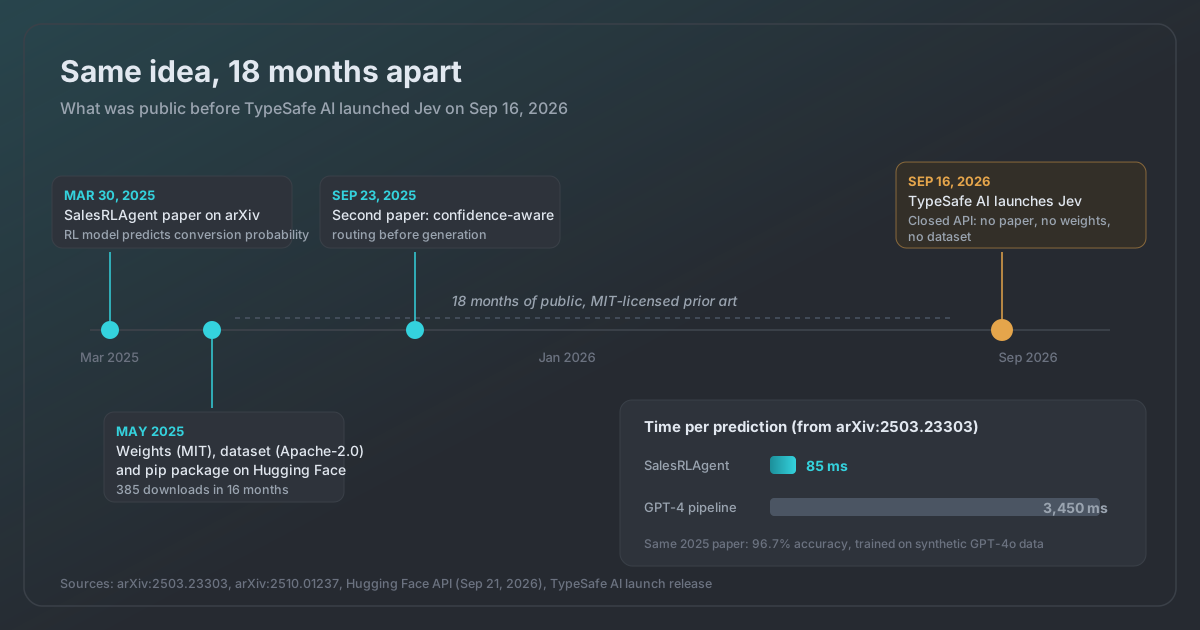
On March 30, 2025, Nandakishor M submitted SalesRLAgent to arXiv. The paper describes a reinforcement learning framework that predicts sales conversion probability turn by turn. The model reads a conversation as 3072-dimension embeddings. It then outputs a probability for each turn, between 0.0 and 1.0. It is trained with PPO instead of next-token prediction. PPO is a reinforcement learning method that updates a policy in small, stable steps. In the paper's tests the model answers in 85 ms, where a GPT-4 pipeline needed 3,450 ms, at a reported 96.7% prediction accuracy.
The sales vertical is not the point here. The point is that everything was published. We measured the public record ourselves on September 21, 2026, straight from the Hugging Face API. The MIT-licensed model went up on May 11, 2025. The Apache-2.0 dataset followed the next day, and the PyPI package (pip install deepmost) on May 24, 2025. Sixteen months later, the model shows 385 downloads and 153 likes.
| Artifact | What it is | Public since | License |
|---|---|---|---|
| arXiv:2503.23303 | SalesRLAgent paper | March 30, 2025 | Open access |
| HF model | PPO conversion predictor | May 11, 2025 | MIT |
| HF dataset | Synthetic sales conversations | May 12, 2025 | Apache-2.0 |
| PyPI deepmost | Python package | May 24, 2025 | MIT |
How similar are Jev and SalesRLAgent, really?
Not identical, and the difference matters. Jev is a horizontal API that outputs confidence distributions and schema choices, trained with RLCD and parallel sampling. SalesRLAgent, in contrast, is a vertical tool that outputs conversion probabilities, trained with PPO over sequence embeddings. Jev is the more general product, and its author says as much.
The family resemblance is the point, however. Both skip token-by-token generation. Both treat the model as a calibrated probability machine with a structured contract. By comparison, a chat model spends most of its compute producing prose around the answer. In fact, the author published a second paper on September 23, 2025, on confidence-aware routing: score the model's confidence before generation, then route the query. It reports hallucination detection at 0.74 against a 0.42 baseline, with 40% lower compute cost than post-hoc correction.
| Jev (TypeSafe AI) | SalesRLAgent (DeepMost) | |
|---|---|---|
| Output | Confidence distributions, JSON schema choices | Turn-by-turn probabilities, 0.0 to 1.0 |
| Training | RLCD, parallel sampling | PPO over sequence embeddings |
| Autoregressive | No | No |
| Scope | Horizontal API | Vertical, sales conversations |
| Paper | None public | arXiv, March 2025 |
| Weights and data | Closed | MIT model, Apache-2.0 dataset |
His newest claim goes further. In a follow-up thread, he says a generic version of his model beats Jev on every benchmark, with code attached. We found no independent reproduction of those numbers, and Jev's evaluation details are not public. Treat that claim as self-reported for now.
Why does this matter if you run models locally?
What does this pattern buy you in practice? A small model that outputs calibrated probabilities directly is exactly the kind of workload that runs on a laptop. An 85 ms predictor over embeddings is CPU-class work, not a datacenter job. If your product needs a routing decision, a churn score or a lead qualifier, you do not need a frontier API for it. For instance, a support team could score every inbound ticket locally, before any text is generated. Why pay per API call for a probability you can compute in-house?
That is the race we track at ModelFit: not who announces a capability, but who ships it in a form you can run. Our open-weights dataset exists because weights you can download beat press releases you cannot. If you want the background on how we test claims like these, see about our approach. And if you have run SalesRLAgent or Jev in production, we would like to hear from you.
The uncomfortable part for open source
Consider the reception gap, in numbers. The open version collected 385 model downloads in 16 months. The closed version got wall-to-wall coverage in 48 hours. "It is incredibly frustrating that the thing you made with months of hard work does not get the support you deserve," the author wrote in his viral post, because a frontier lab built something horizontal. That said, independent invention happens, and TypeSafe AI may never have seen his repository. Priority, however, is a fact of timestamps, and these timestamps are public, indexed and permissively licensed. The gap between the two receptions says less about the technology than about how credit flows in AI. Thus, credit goes to whoever packages an idea horizontally and tells the story loudest. Meanwhile, the person who shipped first is left citing his own arXiv ID in comment threads. As a result, "breakthrough" coverage increasingly needs a five-minute prior-art check before the headline.
FAQ
Is Jev open source?
No. As of September 21, 2026, Jev is available only as a hosted API. TypeSafe AI has published no technical paper, no model weights and no training data. The only public technical detail is the training method's name, RLCD.
Did TypeSafe AI copy SalesRLAgent?
On the other hand, there is no evidence of copying, and parallel invention is common in AI. The verifiable fact is priority: the SalesRLAgent paper dates to March 30, 2025 and the weights to May 11, 2025, about 18 months before Jev launched on September 16, 2026.
Can I run SalesRLAgent locally?
Yes. Install it with pip install deepmost or pull the MIT-licensed weights from Hugging Face. It is a small reinforcement learning policy over text embeddings, so inference is CPU-friendly: the paper reports 85 ms per prediction, against 3,450 ms for a GPT-4 pipeline.
What is RLCD?
RLCD stands for Reinforcement Learning from Calibrated Distributions, TypeSafe AI's training method for Jev. It rewards the model when its stated confidence matches its measured accuracy. That makes the confidence intervals real, not decorative.
What is a System One model?
A System One model is TypeSafe AI's term for a model that returns a decision, a probability and a confidence interval instead of generating prose. The name evokes fast, instinctive judgment, in contrast to slow, deliberate reasoning models.
Bottom line
The architecture behind this week's loudest launch sat on Hugging Face, MIT licensed, for 18 months. Therefore, before calling any model a breakthrough, check the arXiv timestamps. And if you need calibrated probability outputs in production today, the version you can download, audit and run on your own hardware already exists.
Sources and method
- SalesRLAgent paper, arXiv:2503.23303, submitted March 30, 2025
- Confidence-aware routing paper, arXiv:2510.01237, submitted September 23, 2025
- SalesRLAgent model on Hugging Face (MIT)
- SaaS sales conversations dataset (Apache-2.0)
- deepmost on PyPI
- TypeSafe AI launch release and typesafe.ai
- The author's X post and his original and follow-up Reddit threads
We pulled Hugging Face and PyPI metadata through their public APIs on September 21, 2026. Download and like counts are as of that date. The benchmark claim in the follow-up thread is self-reported. We could not verify it, because Jev's weights and evaluation details are not public. Performance figures for both systems come from their respective authors, not from our own test bench. Every figure in this piece passed our editorial fact-check against the linked primary sources.
Match this model to a machine that can run it: by RAM tier for Apple Silicon, or by VRAM for an NVIDIA GPU.
The weekly local-AI refresh
New open-weight models, real Apple Silicon benchmarks, and the one model worth running on your Mac this week. Free, one email a week, unsubscribe anytime.
By subscribing you agree to our Privacy Policy and to receive the weekly email. Unsubscribe anytime.
Have questions? Reach out on X/Twitter