
Somewhere between 4 and 25 months, and the honest answer for laptop hardware is close to 11. A chart claiming laptop-runnable AI trails the cloud frontier by an average of 24.8 months went viral on r/LocalLLaMA this week (KuCoin coverage, 2026). Epoch AI's research says open-weight models lag the frontier by around 4 months (Epoch AI, 2026). Both numbers are real. They measure different things, and the difference is exactly what matters if you own the laptop.
What did the viral chart actually claim?
The chart, posted by an anonymous r/LocalLLaMA user and widely reshared on X, paired past cloud milestones with the date an equivalent model became runnable on a laptop: 37 months for GPT-3, 17 months for GPT-3.5, about 24 for GPT-4, 21 for the Claude 3.5 Sonnet and GPT-4o class, averaging 24.8 months (KuCoin, 2026). The reposts extrapolated: frontier-2026 capability on a laptop by mid-2028.
Two problems. The author and methodology are unknown, and the earliest data points predate modern benchmarks entirely, so "matched GPT-3" rests on vibes more than measurement. That does not make the chart worthless. It makes it uncheckable, which is worse than wrong for anyone making a hardware decision. So we rebuilt the comparison with numbers that can be checked.
What does the verified data say?
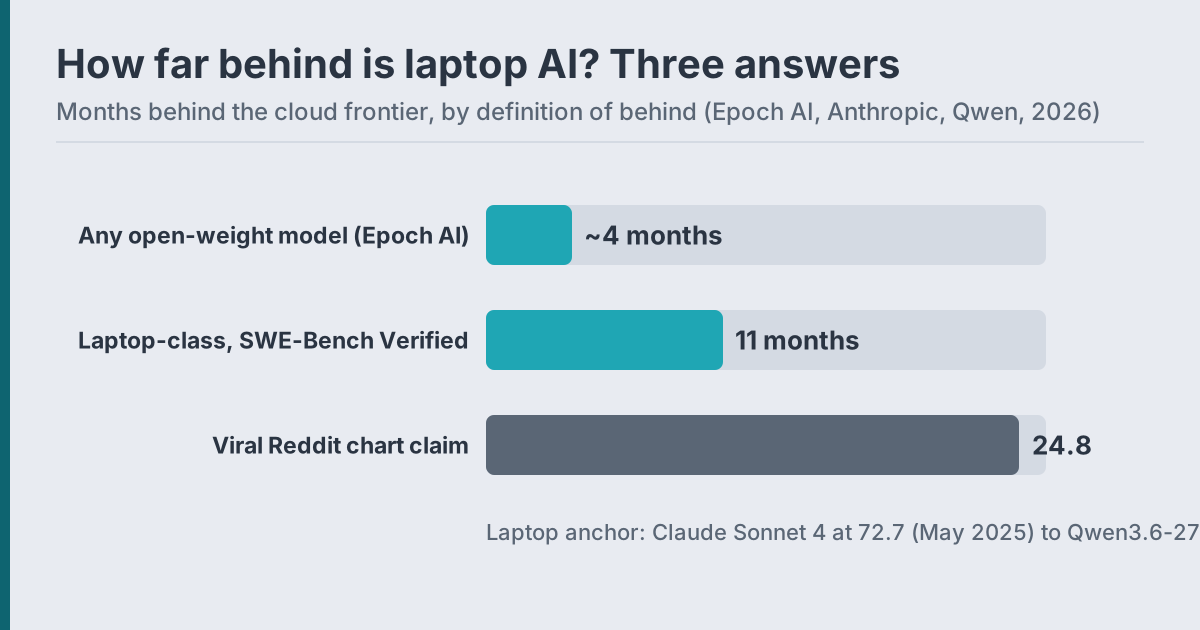
On SWE-Bench Verified, the strictest widely-published coding benchmark, the laptop lag comes out near 11 months, not 24.8. The two cleanest anchors, using each vendor's published scores:
| Milestone | Score (SWE-Bench Verified) | Date |
|---|---|---|
| Claude 3.5 Sonnet (upgraded) | 49% (Anthropic) | Oct 2024 |
| Claude Sonnet 4 | 72.7% (Anthropic) | May 2025 |
| Qwen3.6-27B, runs on a 24GB laptop | 77.2% (model card) | Apr 2026 |
Get told when a better model fits your MacBook Air M5 16 GB
One email when a new open-weight model is a better fit for your machine, plus the Thursday weekly.
For: MacBook Air M5 16 GB
Qwen3.6-27B is a dense 27B model that runs on a 24GB MacBook. It exceeded Claude Sonnet 4's May 2025 score eleven months later, and it did not just match the level, it beat it by 4.5 points. Against the upgraded Claude 3.5 Sonnet of October 2024, the same laptop model represents at most an 18-month lag, and smaller open models likely crossed 49% earlier.
One caveat we will not bury: these scores come from different vendors using their own harnesses, and scaffolds differ. Directionally, though, the pattern is hard to argue with, and it says the laptop lag is closer to one year than two, and shrinking.
Epoch AI measures a third thing: the gap between the best open-weight model of any size and the closed frontier. That lag is around 4 months in 2026, widened slightly from around 3 months in late 2025 (Epoch AI). The catch for laptop owners: the open model doing the catching is usually a 400B to 744B giant that needs a server, not a laptop. The extra months between "open weights exist" and "runs on your machine" are what the viral chart was gesturing at, and what our 11-month anchor actually measures.
Where does the frontier gap stand today?
The top cloud model scores 95 on SWE-Bench Verified against 77.2 for the best consumer-local model, per our continuously verified leaderboard. That 17.8-point gap is today's price of running on your own hardware.
Whether that price is worth paying depends on the task. A 77.2 model handles most day-to-day coding, and it costs $0 per token with no data leaving your machine. The local vs cloud breakdown covers where the gap bites and where it does not.
The lag math also gives the 2026 buyer a concrete rule: hardware outlives model generations. A 24GB machine that runs today's 77.2-class model will run next year's equivalent of today's cloud frontier, because the models keep arriving on schedule while the RAM requirement per capability class keeps falling: 2024's GPT-4-class needed a 70B, 2026's Sonnet-4-class fits in 27B. Check what your current machine already runs with the ModelFit wizard or npx @wecko-ai/modelfit, and size any new purchase with the RAM guide.
FAQ
How long until today's best cloud AI runs on a laptop?
The verified recent anchor is 11 months: Claude Sonnet 4 posted 72.7% on SWE-Bench Verified in May 2025, and the laptop-runnable Qwen3.6-27B posted 77.2% in April 2026. If that pace holds, capability at today's cloud level reaches laptop hardware around mid-2027. The viral 24.8-month figure averages in pre-benchmark-era estimates that cannot be verified.
Why do Epoch AI and the viral chart disagree so much?
They measure different finish lines. Epoch tracks when ANY open-weight model matches the frontier, and that lag is around 4 months, but the matching model is typically a 400B-plus giant needing server hardware. The viral chart tracks laptop-runnable models, which adds the time it takes for capability to compress into a size consumers can run. Verified data puts that laptop lag near 11 months, between the two claims.
What hardware should I buy to ride this curve?
RAM is the lever. The capability that needed a 70B model in 2024 fits a 27B in 2026, so a 24 to 32GB machine now runs what a 64GB+ machine ran two years ago. Buy the tier that fits the model class you want today; the curve keeps improving what that tier runs. The RAM sizing guide maps tiers to model classes.
Is SWE-Bench Verified a fair way to compare cloud and local models?
It is the least unfair option available: a human-validated subset of real GitHub issues, reported by most major vendors. Cross-vendor comparisons still carry scaffold differences, which is why we label them directional. Our leaderboard tracks only Verified scores and re-confirms every row against its source weekly.
Sources
- Viral chart coverage: KuCoin News
- Epoch AI open-vs-closed lag: data insight, 2026 update
- Claude 3.5 Sonnet 49%: Anthropic engineering
- Claude Sonnet 4 72.7%: Anthropic
- Qwen3.6-27B 77.2%: Hugging Face model card
- ModelFit local vs cloud leaderboard: modelfit.io/benchmark
Don't miss the next one for your MacBook Air M5 16 GB
This article covers one moment. Get one email when a newer open-weight model fits your machine better, plus the Thursday weekly with what changed.
For: MacBook Air M5 16 GB
Match this model to a machine that can run it: by RAM tier for Apple Silicon, or by VRAM for an NVIDIA GPU.
Have questions? Reach out on X/Twitter