TL;DR: Apple is reportedly fast-tracking the M7 chip, moving its release up by about half a year, with a rumored base memory bandwidth near 240 GB/s, a 57% jump over the M5's confirmed 153 GB/s. None of this is Apple-confirmed, and it targets 2027. The M5 already handles 7B to 14B models well today, so most people should buy now.
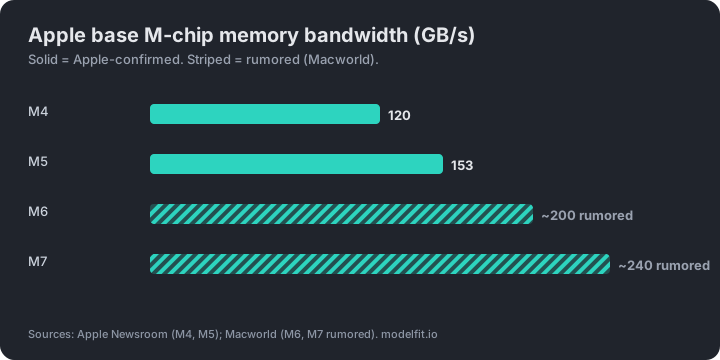
Apple is reportedly fast-tracking the M7 chip to win on-device AI, moving the whole generation up by about half a year, with a rumored base memory bandwidth around 240 GB/s (Macworld, 2026). That would be a real jump for running local LLMs. The catch: it is a rumor for 2027, and the best Mac for local AI is the one you can use today. This guide separates the confirmed from the rumored, and tells you what to run now.
Memory bandwidth is the single number that most decides how fast a Mac generates tokens, because local model decode is memory-bound. So a bandwidth jump matters more for local AI than a flashy core count. Below we cover the reported M7 roadmap, what the rumored numbers would mean, and a clear buy-now-or-wait answer anchored on Apple's confirmed M5 figure.
What is the Apple M7 and when does it arrive?
The M7 is Apple's next chip generation, and a report says Apple is pulling it forward to focus on local AI. According to Macworld, Apple plans to ship the base M6 on time this fall but skip the M6 Pro and Max, then "fast-track the M7 generation, moving up its release dates by as much as half a year" (Macworld, 2026).
The reported timeline: M7 products could arrive in the first half of 2027, with M7 Pro and M7 Max in late 2027 and an M7 Ultra in 2028 (Macworld, 2026). Treat all of this as a rumor. Apple has not confirmed any M6 or M7 specification, and dates can slip. The article itself is filed under rumors.
How much faster would the M7 be for local AI?
The reported gain is meaningful but not confirmed. Macworld states the base M7 "will have memory bandwidth of around 240 gigabytes per second, a 20 percent boost over the rumored 200 GB/sec of the coming M6, and about 57 percent higher than the 153 GB/sec of the current M5" (Macworld, 2026).
Only one number there is solid: the M5's 153GB/s, which Apple published as a nearly 30 percent gain over the M4's 120GB/s (Apple Newsroom, 2025). The 200 and 240 figures are rumors. If they hold, a base M7 would generate tokens meaningfully faster than today's base M5, since decode speed scales with bandwidth. Pro and Max versions would scale up from there, per the same report.
What would that mean for running local LLMs?
A bandwidth jump speeds up token generation, but it does not change what fits. Two properties matter for local LLMs on a Mac, and they are different. Memory capacity decides which model loads at all. Memory bandwidth decides how fast it replies. A faster M7 with the same 16GB or 24GB would answer quicker, yet still fit the same size of model as an M5 at that memory tier.
This is why "which bottleneck am I buying" beats "which chip is fastest." If you run large models, you want more unified memory, not just more bandwidth. If you run smaller models and want snappier replies, bandwidth is your lever. We break down the full capacity, bandwidth, and software stack trade in the local AI hardware bottleneck guide.
Should you wait for the M7 or buy now?
For most people, do not wait. The M7 is a 2027 rumor with no confirmed specs, and current Apple silicon already runs capable local models well. The current M5 at 153GB/s is a strong base for 7B to 14B class models, and higher-memory Macs handle much larger ones. Buying a year of use now usually beats waiting on an unconfirmed chip.
Wait only if all three apply: you do not need a Mac until 2027, your work is bottlenecked specifically by token generation speed, and you want the newest on-device AI silicon. In that narrow case the reported M7 bandwidth gain could be worth the wait. Otherwise, match a current Mac to your workload today. To pick the right one, run the ModelFit wizard or read the best LLM for the M5 MacBook Air.
What does your current Mac run today?
Capacity sets the ceiling. Use this rough ladder, then confirm the real pick for your exact chip and memory:
- 8GB: 7B to 8B class models at a 4-bit quant
- 16GB: 13B to 14B class
- 24GB to 32GB: 24B to 32B class
- 64GB and up: 70B class
These are starting points, not promises, because bandwidth, context length, and the quant all shift the best choice. For the exact answer on your machine, use the ModelFit wizard, check the how much RAM for local LLM guide, or run the open CLI:
npx @wecko-ai/modelfitThe open hardware dataset lists model and hardware fits if you want the underlying numbers.
FAQ
When will the Apple M7 launch?
A report says M7 products could arrive in the first half of 2027, with M7 Pro and Max in late 2027 and an M7 Ultra in 2028 (Macworld, 2026). Apple has not confirmed this. Treat the dates as a rumor that can change.
How much memory bandwidth will the M7 have?
The rumored figure is around 240 GB/s for the base M7, reported as about 57 percent higher than the current M5's confirmed 153GB/s (Macworld, 2026). Only the M5 number is Apple-confirmed. The 240 figure is unconfirmed and should be treated as a rumor.
Is Apple really skipping the M6 Pro and Max?
That is the report. Macworld says the base M6 ships this fall on schedule, but Apple skips the M6 Pro and Max and brings the full M7 generation forward by up to half a year (Macworld, 2026). Apple has not commented, so this remains a rumor.
Should I wait for the M7 to run local AI?
For most users, no. The M7 is a 2027 rumor, while current Apple silicon already runs strong local models. Wait only if you do not need a Mac until 2027 and your work is limited specifically by token generation speed. Otherwise, match a current Mac to your workload now with the ModelFit wizard.
Does more memory bandwidth mean I can run bigger models?
No. Bandwidth speeds up how fast a model generates tokens, but memory capacity decides what fits. A faster M7 with the same memory as an M5 would reply quicker on the same size of model, not unlock a larger one. To run bigger models you need more unified memory, not just more bandwidth.
Sources
- Macworld, Apple to skip M6 Pro/Max chips, fast-track M7 for local AI: https://www.macworld.com/article/3177046/report-apple-to-skip-m6-pro-max-chips-fast-track-m7-for-local-ai.html
- Apple Newsroom, M5: https://www.apple.com/newsroom/2025/10/apple-unleashes-m5-the-next-big-leap-in-ai-performance-for-apple-silicon/
- Apple Newsroom, M4 Pro and M4 Max: https://www.apple.com/newsroom/2024/10/apple-introduces-m4-pro-and-m4-max/
Match this model to a machine that can run it: by RAM tier for Apple Silicon, or by VRAM for an NVIDIA GPU.
The weekly local-AI refresh
New open-weight models, real Apple Silicon benchmarks, and the one model worth running on your Mac this week. Free, one email a week, unsubscribe anytime.
By subscribing you agree to our Privacy Policy and to receive the weekly email. Unsubscribe anytime.
Have questions? Reach out on X/Twitter